This is the free Comptia CV0-004 practice question bank —
100 of 182 total questions, each with a full explanation, free to
read with no signup required. Updated 2026-10-13.
Every answer is verified against official Comptia documentation —
see our methodology.
Question 1
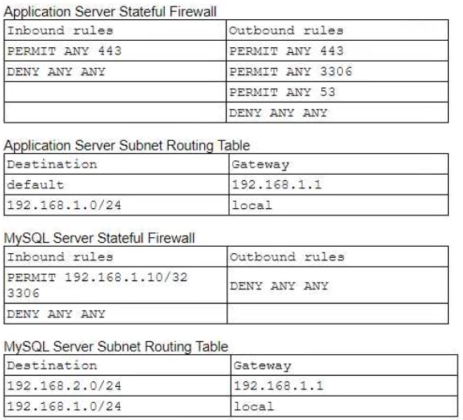
A cloud engineer is troubleshooting a connectivity issue. The application server with IP 192.168.1.10 in one subnet is not connecting to the MySQL database server with IP 192.168.2.20 in a different subnet. The cloud engineer reviews the following information:
Which of the following should the cloud engineer address to fix the communication issue?
A. The Application Server Stateful Firewall
B. The Application Server Subnet Routing Table
C. The MySQL Server Stateful Firewall
D. The MySQL Server Subnet Routing Table
Show Answer
Correct Answer: D
Explanation: The MySQL server’s subnet routing table is misconfigured: it marks 192.168.1.0/24 as local even though the MySQL server is in 192.168.2.0/24. Correct the local route and the route back to the application subnet. The application subnet has a default route, and the MySQL firewall permits inbound MySQL traffic from 192.168.1.10.
Sources:
https://unix.stackexchange.com/questions/527012/routing-problems-when-activating-ip-forwarding?lastactivity=
Question 1
Which of the following compute services is the best for quick and easy provisioning?
A. Cluster
B. Container
C. Server less
D. Snapshot
Show Answer
Correct Answer: C
Explanation: Serverless compute is designed for the quickest and easiest provisioning because the cloud provider manages the underlying servers and infrastructure. Clusters require provisioning multiple machines, containers still require a container runtime or orchestration platform, and snapshots are storage artifacts rather than compute services.
Sources:
https://www.peerspot.com/questions/what-is-the-best-compute-service-solution
Question 1
An engineer receives information about an application issue and reviews the events. The engineer decides to horizontally scale the application server. Which of the following would most likely explain the engineer's decision?
A. The web server reached the maximum number of TCP sessions.
B. Ephemeral storage for the server OS reached 90%.
C. A runtime error in the application logs indicated a bug in the application.
D. The application server averages 50% CPU and spiked to 90% CPU.
Show Answer
Correct Answer: D
Explanation: Horizontal scaling adds application-server instances to distribute compute workload. Of the choices, high CPU usage—spiking to 90%—most suggests the application tier may need more capacity. Storage pressure or an application bug would not be addressed by adding instances, and the TCP-session limit is described on the web server.
Question 2
Which of the following allows network access to services deployed in a container?
A. Forward proxy
B. Network orchestration
C. Host affinity
D. Port mapping
Show Answer
Correct Answer: D
Explanation: Port mapping exposes a containerized service by binding a port on the host to a port inside the container, allowing external network access. The other options do not directly provide access to services running inside a container.
Question 2
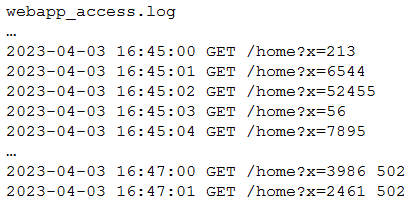
A company’s website suddenly crashed. A cloud engineer investigates the following logs:
Which of the following is the most likely cause of the issue?
A. SQL injection
B. Cross-site scripting
C. Leaked credentials
D. DDoS
Show Answer
Correct Answer: D
Explanation: The repeated requests to the website followed by 502 errors are most consistent with a DDoS overwhelming the service and making it unavailable. The logs do not show SQL injection payloads, cross-site scripting code, or evidence of credential misuse.
Question 2
An administrator used a script that worked in the past to create and tag five virtual machines. All of the virtual machines have been created; however, the administrator sees the following results:
{tags: []}
Which of the following is the most likely reason for this result?
A. API throttling
B. Service quotas
C. Command deprecation
D. Compatibility issues
Show Answer
Correct Answer: C
Explanation: Because all five VMs were created, quotas and VM-creation throttling are unlikely causes. The empty tags result most likely means the script’s previously working tagging command has been deprecated or changed and no longer applies tags as expected.
Question 3
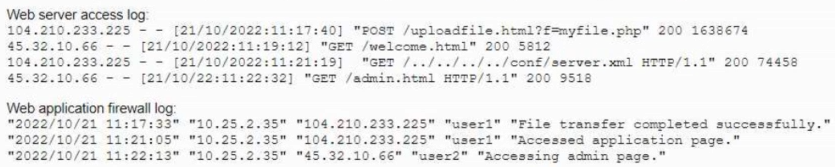
A cloud security analyst is investigating the impact of a recent cyberattack. The analyst is reviewing the following information:
Which of the following has occurred?
A. The corporate administration page was defaced by the attacker
B. A denial-of-service attack was successfully performed on the web server
C. A new user was created on the web server by the attacker
D. Sensitive information from the corporate web server was leaked
Show Answer
Correct Answer: D
Explanation: The access log shows a request for `/../../../../conf/server.xml` that returned HTTP 200, indicating the server returned the sensitive configuration file. The other log entries do not show a defacement, denial-of-service attack, or creation of a new user.
Question 3
A development team is ready to release the latest version of an application. Which of the following strategies best ensures successful deployment without impacting the bandwidth of company resources?
A. Blue-green
B. A/В testing
C. Rolling
D. Shadow
Show Answer
Correct Answer: D
Explanation: Shadow deployment mirrors production traffic to the new version while keeping user-facing responses on the current version. This validates the release under real load with no impact to end users and avoids shifting live user traffic during validation. Blue-green, rolling, and A/B testing all direct some or all live traffic to the new version.
Sources:
https://namastedev.com/blog/continuous-deployment-strategies
Question 4
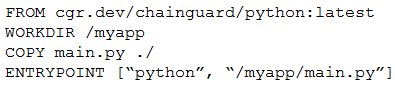
A cloud engineer is reviewing the following Dockerfile to deploy a Python web application:
Which of the following changes should the engineer make to the file to improve container security?
A. Add the instruction USER nonroot.
B. Change the version from latest to 3.11.
C. Remove the ENTRYPOINT instruction.
D. Ensure myapp/main/py is owned by root.
Show Answer
Correct Answer: A
Explanation: Running the application as a non-root user limits the damage if the container is compromised. The Chainguard Python image may already default to a non-root user, but explicitly setting `USER nonroot` makes that security intent clear and enforced in the Dockerfile.
Question 4
A cloud engineer is selecting a model for a data center that will host a workload. The database must reside within the data center on the company's SAN solution. However, the workload will be hosted by a third-party vendor. Which of the following models should the cloud engineer select to meet these requirements?
A. Community
B. Hybrid
C. Public
D. Private
Show Answer
Correct Answer: B
Explanation: A hybrid model combines on-premises infrastructure with externally hosted resources. Keeping the database on the company's SAN in its own data center while hosting the workload with a third-party provider matches a hybrid deployment model.
$19
Get all 182 questions with detailed answers and explanations
Instant download HTML + PDF delivered the moment payment clears.
Secure Stripe checkout we never see or store your card details.
7-day refund if files are defective see our refund policy.