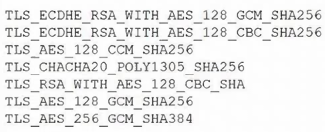
A vulnerability scan was performed on a website, and the following encryption suites were found:
Which of the following actions will remediate the vulnerability?
A. Removing any ciphers utilizing cipher block chaining
B. Rearranging the order of the ciphers from strongest to weakest
C. Deploying a WAF to monitor web traffic
D. Reissuing new SSL certificates for the website
Show Answer
Correct Answer: A
Explanation: The scan identifies cipher suites that use cipher block chaining (CBC). Removing CBC suites and allowing stronger authenticated-encryption suites, such as GCM or ChaCha20-Poly1305, remediates the vulnerability. Changing cipher order does not disable the vulnerable suites.
Question 38
A developer used their workstation to generate keys that are used to secure a mission-critical application. A security engineer needs to reduce the risk of unauthorized disclosure of keying material. Which of the following is the best way to increase the security of the process?
A. HSM
B. SED
C. FDE
D. TPM
Show Answer
Correct Answer: A
Explanation: An HSM is designed to securely generate, store, and manage cryptographic keys, keeping keying material protected from exposure on the workstation. SED and FDE protect data at rest, while a TPM primarily supports platform security and key operations rather than serving as the best dedicated key-management solution.
Question 38
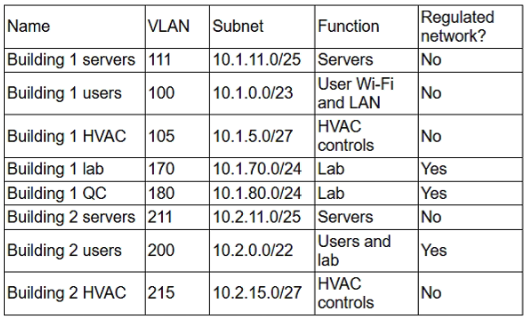
A pharmaceutical lab hired a consultant to identify potential risks associated with Building 2, a new facility that is under construction. The consultant received the IT project plan, which includes the following VLAN design:
Which of the following TTPs should the consultant recommend be addressed first?
A. Zone traversal
B. Unauthorized execution
C. Privilege escalation
D. Lateral movement
Show Answer
Correct Answer: A
Explanation: Building 2’s user and lab systems share VLAN 200, which is marked as part of the regulated network. This weak segmentation creates a zone-traversal risk between general user devices and regulated lab systems. Address the boundary and segmentation first; lateral movement is a possible subsequent attacker behavior, not the underlying design issue.
Question 39
During a penetration test, several users report that certain fileshares on the network could not be accessed. An analyst reviews the network traffic and detects a high number of packets associated with LLMNR and SMB that are being redirected to the penetration tester’s computer. Which of the following attacks is causing the issue?
A. SMB brute-force
B. Directory fuzzing
C. NTLM relay
D. Network poisoning
Show Answer
Correct Answer: D
Explanation: This is LLMNR poisoning: the tester sends misleading name-resolution responses that redirect SMB traffic to their computer, disrupting access to the fileshares. NTLM relay may be a related follow-on technique, but the described traffic redirection is network poisoning.
Question 39
A security engineer discovers that some legacy systems are still in use or were not properly decommissioned. After further investigation, the engineer identifies that an unknown and potentially malicious server is also sending emails on behalf of the company.
The security engineer extracts the following data for review:
Which of the following actions should the security engineer take next? (Choose two.)
A. Rotate the DKIM selector to use another key.
B. Change the DMARC policy to reject and remove references to the server.
C. Remove the unnecessary servers from the SPF record.
D. Change the SPF record to enforce the hard fail parameter.
E. Update the MX record to contain only the primary email server.
F. Change the DMARC policy to none and monitor email flow to establish a new baseline.
Show Answer
Correct Answer: B, D
Explanation: Set DMARC to reject so messages that fail authentication and alignment are blocked, and configure SPF with a hard fail (`-all`) so unlisted senders fail SPF explicitly. Do not rotate DKIM keys without evidence they were compromised, and MX records affect inbound routing rather than outbound authorization.
Question 40
A security consultant recommends that a solution be deployed to increase awareness of APTs throughout the IT and ОТ environments. The consultant's requirements state that the solution must:
• Be capable of collecting data from both ОТ and IT protocols.
• Operate within new microsegmented and air-gapped network architecture
• Provide both correlation of events and retention of raw log data and incidents
• Integrate with the ITSM platform and employee paging system
Which of the following solutions best meets these requirements?
A. SASE deployment with an Always On VPN
B. A next-generation firewall with intrusion prevention services
C. A vulnerability scanner with agentless scanning
D. SIEM with remote collectors
Show Answer
Correct Answer: D
Explanation: A SIEM with remote collectors can gather logs and telemetry from IT and OT protocols across segmented or air-gapped networks, then correlate events and retain raw logs and incident records. SIEM platforms commonly integrate with ITSM and paging systems. The other options do not provide this combination of centralized security-event correlation and log retention.
Question 40
A company reduced its staff 60 days ago, and applications are now starting to fail. The security analyst is investigating to determine if there is malicious intent for the application failures. The security analyst reviews the following logs:
Which of the following is the most likely reason for the application failures?
A. The user’s account was set as a service account
B. The user's home directory was deleted
C. The user does not have sudo access.
D. The root password has been changed
Show Answer
Correct Answer: A
Explanation: The login failure described is consistent with an account configured as a non-interactive service account. If the applications still depend on that former employee’s account for interactive authentication, they would fail after the account change.
Question 41
A security analyst is designing a network structure to support a virtual server that is running an unsupported operating system The unsupported operating system contains PII and is business critical. Given the following information:
• The PII server name is legacy-box, and the machine IP is 192.168.1.100.
• The jump-box server name is jump-box with an IP of 192.168.1.10
• The IP address scheme for the corporate network is 192.168.1.0/24
The machines with the following IP addresses need access
• 192.168.1.3
• 192.168.1.4
Which of the following actions should the analyst do to best secure the PII server?
A. Configure jump-box and legacy-box with dual NICs, giving them both virtual network and corporate network IP addresses
B. Modify host firewall rules and routes on legacy-box to permit only 192.168.1.3 and 192.168.1.4 to RDP
C. Set up host firewall rules and routes on jump-box to permit only 192.168.1.3 and 192.168.1.4 to RDP
D. Implement host firewall rules and routes on legacy-box to permit only 192.168.1.0/24 to RDP and deny everything else
Show Answer
Correct Answer: B
Explanation: Restricting RDP on legacy-box to 192.168.1.3 and 192.168.1.4 directly limits access to the PII server. Restricting only jump-box would not prevent other corporate hosts from connecting directly to legacy-box, which is also on the corporate subnet.
Sources:
https://community.cisco.com/t5/network-management/what-is-jump-server-or-jump-box/td-p/4684022
Question 41
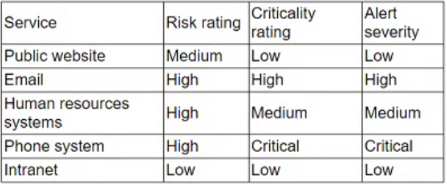
After an incident response exercise, a security administrator reviews the following table:
Which of the following should the administrator do to best support rapid incident response in the future?
A. Automate alerting to IT support for phone system outages.
B. Enable dashboards for service status monitoring.
C. Send emails for failed log-in attempts on the public website.
D. Configure automated isolation of human resources systems.
Show Answer
Correct Answer: A
Explanation: The phone system has both critical service criticality and critical alert severity. Automatically notifying IT support of phone system outages helps the team respond quickly to the highest-priority incidents.
Question 42
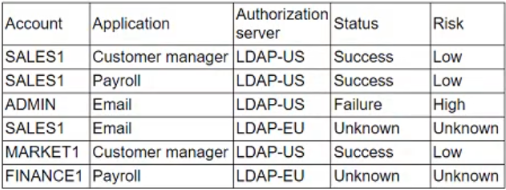
A security analyst is reviewing suspicious log-in activity and sees the following data in the SIEM:
Which of the following is the most appropriate action for the analyst to take?
A. Update the log configuration settings on the directory server that is not being captured properly.
B. Have the admin account owner change their password to avoid credential stuffing.
C. Block employees from logging in to applications that are not part of their business area.
D. Implement automation to disable accounts that have been associated with high-risk activity.
Show Answer
Correct Answer: A
Explanation: LDAP-EU events show unknown status and risk, indicating that authentication activity from that directory server is not being captured or classified properly. The analyst should correct its logging configuration to restore visibility before taking account-level action. A failed high-risk login alone does not establish that an account should be automatically disabled.
$19
Get all 406 questions with detailed answers and explanations
Instant download HTML + PDF delivered the moment payment clears.
Secure Stripe checkout we never see or store your card details.
7-day refund if files are defective see our refund policy.