Which of the following best explains an AI model denial-of-service attack?
A. Users posting large, computationally intensive data sets
B. Untrustworthy and unverified model output
C. An adversary attacking the API of an AI service
D. Using the model output to understand its parameters or architecture
Show Answer
Correct Answer: A
Explanation: A model denial-of-service attack overwhelms the model with large or computationally intensive inputs, exhausting resources and making the service slow or unavailable. Inferring a model’s parameters from its output (D) is model extraction, not denial of service.
Sources:
https://troj.ai/blog/model-denial-of-service
https://chainofthought.show/glossary/model-denial-of-service
Question 8
An organization receives intelligence information about a foreign adversary targeting instances of a web server application that the organization uses. The information includes:
• The originating IP addresses of the attack
• The common commands run on the affected device
• The indicators that a device has been affected
• The actions that can be taken on the device to stop the attack
Which of the following should the organization do first?
A. Draft an incident response playbook
B. Build tactics, techniques, and procedures
C. Create Snort and YARA rules
D. Configure user behavior analytics
Show Answer
Correct Answer: C
Explanation: The organization should first turn the actionable indicators and observed behaviors into detection rules so it can identify and investigate attacks against its web servers. Snort can detect relevant network activity, while YARA can match file or memory artifacts. A playbook may help coordinate response, but the intelligence already provides the indicators needed for immediate detection.
Question 9
Which of the following preconditions must be met in order for homomorphic encryption to become practical in mainstream data-in-use applications?
A. Availability of updated ECC curves that provide quantum resistance
B. Coprocessors made available with more appropriate security extensions
C. Finalization of a standard PQC suite of lattice- and code-based algorithms
D. Capability to run the most advanced LLMs while disconnected from the internet
Show Answer
Correct Answer: B
Explanation: Homomorphic encryption is computationally expensive. More suitable coprocessors and hardware extensions could accelerate encrypted computation enough for mainstream data-in-use applications. Quantum-resistant ECC curves, a finalized PQC suite, and offline LLM capability are not prerequisites.
Question 9
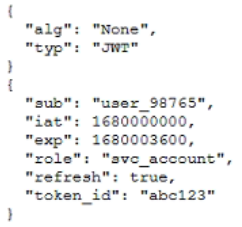
An application security engineer is examining the IAM configuration for a workload. The following is a sample of the decoded payload and header:
Which of the following is the most concerning risk?
A. Lateral movement
B. Privilege escalation
C. Credential stuffing
D. RCE from deserialization
Show Answer
Correct Answer: B
Explanation: The JWT header specifies `alg: None`, meaning the token may be accepted without a signature. An attacker could alter claims—such as the role—and forge a token with elevated permissions, creating a privilege-escalation risk.
Question 9
A security architect is designing Zero Trust enforcement policies for all end users. The majority of users work remotely and travel frequently for work. Which of the following controls should the security architect do first?
A. Switch user MFA from software-based tokens to hardware time-based OTPs.
B. Implement TLS decryption and inspect inbound and outbound network traffic.
C. Enforce daily posture compliance checks against the endpoint security controls.
D. Deploy context-aware reauthentication with UBA baseline deviations.
Show Answer
Correct Answer: D
Explanation: Context-aware reauthentication with UBA can respond to changing locations and travel patterns by prompting for additional verification when activity deviates from a user’s normal behavior. This supports Zero Trust enforcement for a mobile workforce without relying on a fixed network perimeter.
Question 10
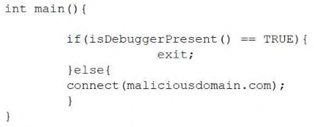
A reverse engineer is analyzing a malware sample from a recent security incident. When debugging and disassembling the code, the engineer finds the following section of the code:
Which of the following does this malware try to evade?
A. IOC extraction
B. Code similarity
C. Dynamic analysis
D. Malware attribution
Show Answer
Correct Answer: C
Explanation: The malware checks whether a debugger is present and exits if it finds one. That behavior is intended to evade dynamic analysis, which involves running and debugging the sample.
Sources:
https://cybersecuritynews.com/ida-9-0-released
Question 10
An analyst is using the Diamond Model of Intrusion Analysis to identify the likely chain of activities associated with an attacker's activities. The threat hunter has completed the core components of the model but needs to consider meta factors to more deeply understand the situation. Which of the following should the threat hunter seek to understand within the model?
A. Direction
B. Velocity
C. Capabilities
D. Infrastructure
Show Answer
Correct Answer: A
Explanation: Direction is a Diamond Model meta-feature. Capabilities and Infrastructure are core features, while Velocity is not a standard feature of the model.
Question 11
A security engineer must reduce overhead of routine security administration tasks with SOAR. Which of the following should the engineer do to best meet this objective?
A. Perform static analysis of potentially malicious software.
B. Enrich data based on threat intelligence feeds
C. Apply context-based access restrictions at scale
D. Change the enterprise password policy requirements
Show Answer
Correct Answer: B
Explanation: SOAR can automatically enrich security data with threat intelligence, eliminating a repetitive manual task. The other options are not typical SOAR administrative workflows.
Sources:
https://www.veritis.com/blog/what-is-soar-in-cybersecurity
Question 11
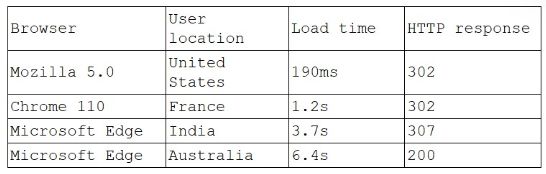
A company receives several complaints from customers regarding its website. An engineer implements a parser for the web server logs that generates the following output:
Which of the following should the company implement to best resolve the issue?
A. IDS
B. CDN
C. WAF
D. NAC
Show Answer
Correct Answer: B
Explanation: The log shows page load times increasing significantly for users farther from the server, suggesting latency due to geographic distance. A CDN caches and serves content from locations closer to users, improving load times. The HTTP redirect responses do not point to a need for an IDS, WAF, or NAC.
Question 11
A systems engineer is configuring a system baseline for servers that will provide email services. As part of the architecture design, the engineer needs to improve performance of the systems by using an access vector cache, facilitating mandatory access control, and protecting against:
• Unauthorized reading and modification of data and programs
• Bypassing application security mechanisms
• Privilege escalation
• Interference with other processes
Which of the following is the most appropriate for the engineer to deploy?
A. SELinux
B. Privileged access management
C. Self-encrypting disks
D. NIPS
Show Answer
Correct Answer: A
Explanation: SELinux implements mandatory access control (MAC) in the Linux kernel and uses an Access Vector Cache (AVC) to improve performance by caching access decisions. Its policy enforcement helps prevent unauthorized access or modification, application security bypasses, privilege escalation, and interference between processes.
$19
Get all 406 questions with detailed answers and explanations
Instant download HTML + PDF delivered the moment payment clears.
Secure Stripe checkout we never see or store your card details.
7-day refund if files are defective see our refund policy.