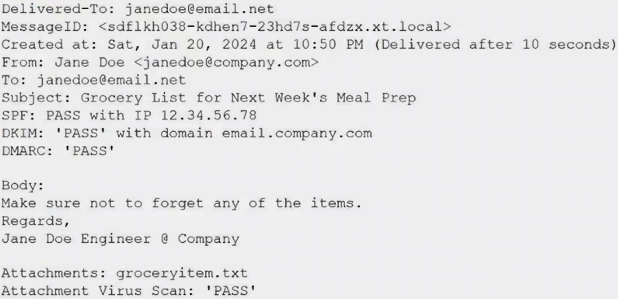
Protected company data was recently exfiltrated. The SOC did not find any indication of a network or outside physical intrusion, and the DLP systems reported no unusual activity. The incident response team determined a text file was encrypted and reviews the following:
Which of the following is the most appropriate action for the team to take?
A. Review the email security settings for proper configurations.
B. Investigate whether the employee had access to the data that was leaked.
C. Scan attachments with a third-party virus scan to independently confirm the results.
D. Analyze the hardware for undetected supply chain vulnerabilities that may have been exploited.
Show Answer
Correct Answer: B
Explanation: With no evidence of network or physical intrusion and DLP reporting no unusual activity, the team should determine whether the employee had legitimate access to the leaked data. The email authentication and attachment virus scan results do not establish who accessed or exfiltrated the data.
Question 32
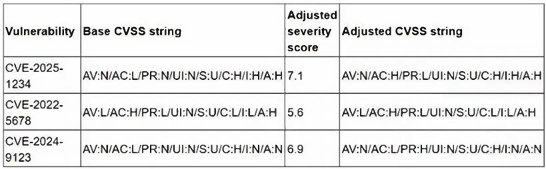
A security team is evaluating the following vulnerabilities in response to a third-party risk assessment:
Given the following organizational policy requirements:
• Any adjusted CVSS score of 7.0 or greater must be remediated within 15 days.
• Any adjusted CVSS score of 6.9 or less must be remediated within 30 days.
• Any vulnerability with a known public exploit must be remediated within seven days.
• Any vulnerability that requires high privileges can have a lower severity.
Which of the following actions should the analyst do to meet the requirements on time?
A. Implement a patch for CVE-2025-1234.
B. Accept risk for CVE-2022-5678.
C. Make an exception within the insurance policy for CVE-2022-5678.
D. Add CVE-2024-9123 to the risk register.
E. Decommission the systems affected by CVE-2024-9123.
Show Answer
Correct Answer: A
Explanation: CVE-2025-1234 has an adjusted CVSS score of 7.1, so policy requires remediation within 15 days. Applying a patch meets that requirement; accepting risk or recording a vulnerability does not remediate it.
Question 33
A small number but steady series of attempts to breach the network has been occurring over a long period of time. During an investigation, a SOC analyst finds that traffic is exiting the network to known malicious hosts and is originating from a rogue network device. Which of the following attack vectors is most likely being used to breach the network?
A. Supply chain
B. Buffer overflow
C. Social engineering
D. Ransomware
Show Answer
Correct Answer: A
Explanation: A rogue network device communicating with known malicious hosts suggests a compromised or malicious device introduced into the environment, making a supply-chain attack the best fit. The evidence does not specifically indicate a buffer overflow, social engineering, or ransomware.
Question 33
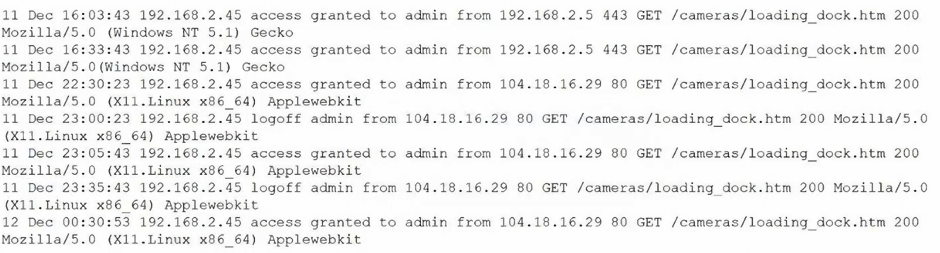
A building camera is remotely accessed and disabled from the remote console application during off-hours. A security analyst reviews the following logs:
Which of the following actions should the analyst take to best mitigate the threat?
A. Implement WAF protection for the web application.
B. Upgrade the firmware on the camera.
C. Only allow connections from approved IPs.
D. Block IP 104.18.16.29 on the firewall.
Show Answer
Correct Answer: C
Explanation: The logs show admin access granted from an unapproved external IP. Restricting connections to approved IPs (ideally through a VPN or trusted network) prevents unauthorized access while preserving legitimate administration. Blocking only the observed IP is reactive, and a WAF or firmware upgrade does not directly address the exposed management interface.
Question 34
The Chief Information Security Officer (CISO) asks the security team whether their SOC is receiving IoCs from an industry ISAC Which of the following is the most likely reason the CISO is interested in obtaining this information?
A. To ensure the SOC is able to detect known attacks against similar organizations
B. To ensure the SOC is proactively preventing potential attacks
C. To ensure the SOC orchestration playbooks are up to date
D. To ensure the SOC is aligned with industry best practices
Show Answer
Correct Answer: A
Explanation: An industry ISAC shares threat intelligence, including indicators of compromise (IoCs) observed across peer organizations. The SOC can use these IoCs to detect known attacks that may also target similar organizations.
Question 34
A malware analyst must examine the following partial file sample recovered from a Linux workstation:
Attempts to run the code in a sandbox produce no results. Which of the following should the malware analyst do next to further analyze the malware and discover useful IoCs?
A. Convert the hex-encoded sample to binary and attempt to decompile it.
B. Run the encoded sample through an online vulnerability tool and check for any matches.
C. Pad the beginning and end of the sample with binary executables and attempt to execute it.
D. Use a disassembler on the unencoded snippet to convert from binary to ASCII text.
Show Answer
Correct Answer: A
Explanation: The sample is shown as hexadecimal bytes and begins with `4D 5A` (`MZ`), indicating a Windows executable format. Convert the hex data into a binary file, then analyze it statically with appropriate disassembly or decompilation tools to look for useful indicators of compromise. The other options do not appropriately analyze the sample.
Question 35
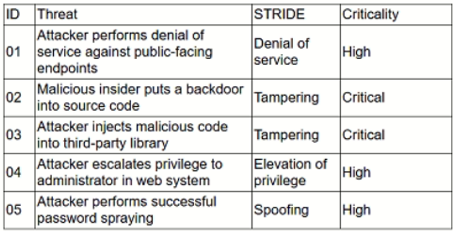
A security architect is performing threat-modeling activities related to an acquired overseas software company that will be integrated with existing products and systems. Once its software is integrated, the software company will process customer data for the acquiring company. Given the following:
Which of the following mitigations would reduce the risk of the most significant threats?
A. Privileged access management system with conditional access capabilities to prevent unauthorized access
B. Rate-limiting capabilities on all authentication systems and leveraging single sign-on through federation
C. Secure development process with gate checks and appropriate code scanning
D. Zero Trust architecture for all assets from the acquired company using microsegmentation against sensitive applications
Show Answer
Correct Answer: C
Explanation: The highest-criticality threats are malicious code inserted into the source code or a third-party library. A secure development process with gate checks and code scanning helps detect and prevent these threats before the software is integrated. The other options primarily address access, authentication, or containment risks.
Question 36
A Chief Information Security Officer (CISO) is developing a third-party risk management program and wants to establish an order of preference for solicitation and acceptance of audit and assessment results from business partners. The CISO prefers a formal certification against an established framework, which should be considered more reliable than self-attestations. Which of the following is most likely the reason for this perspective?
A. Certifications are typically issued against a formal standard.
B. Assessments are based on evidence, not judgments.
C. For standards like PCI. self-attestations are more reliable than certifications.
D. A certification audit is managed by a central authority.
Show Answer
Correct Answer: A
Explanation: A formal certification is issued against a defined standard, making its criteria more consistent and verifiable than a partner’s self-attestation. Certification audits are not necessarily managed by a central authority.
Sources:
https://fractionalciso.com/soc-2-certification
Question 36
A security analyst discovers a compromised internal server and finds that the attack vector was an application. When extracting a memory dump with the application process content, the analyst observes the following:
Which of the following solutions should the analyst recommend to best address this issue and avoid reoccurrence?
A. Implement address space layout randomization and canary stacks.
B. Reduce the buffer size to allow for less stored data.
C. Improve character filtering and input validation for user inputs.
D. Allow only the use of digitally signed and validated libraries.
Show Answer
Correct Answer: A
Explanation: The repeated 0x90 bytes indicate a NOP sled, commonly used in a buffer-overflow exploit. Address space layout randomization and stack canaries make this type of exploit harder to execute and detect stack corruption.
Question 37
A company in a regulated industry experiences a data breach after an employee clicks on an email phishing link and enters credentials, leading to the exposure of sensitive information. Which of the following should the company do to prevent future attacks? (Choose two.)
A. Deploy a NAC.
B. Implement deep packet inspection.
C. Establish password complexity requirements.
D. Implement a WAF.
E. Enforce multifactor authentication.
F. Create a security awareness training program.
Show Answer
Correct Answer: E, F
Explanation: Security awareness training helps employees recognize and avoid phishing links. Multifactor authentication reduces the risk that stolen credentials alone will allow an attacker to access sensitive information. Password complexity does not help when a valid password is disclosed.
Sources:
https://www.mapletech.co.uk/blog/what-to-do-if-an-employee-clicks-a-phishing-link
https://www.forbes.com/councils/forbesbusinesscouncil/2022/03/18/how-to-prevent-accidental-data-exposure-within-your-company
$19
Get all 406 questions with detailed answers and explanations
Instant download HTML + PDF delivered the moment payment clears.
Secure Stripe checkout we never see or store your card details.
7-day refund if files are defective see our refund policy.