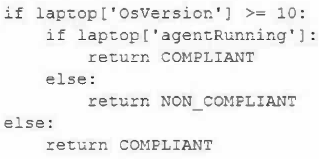
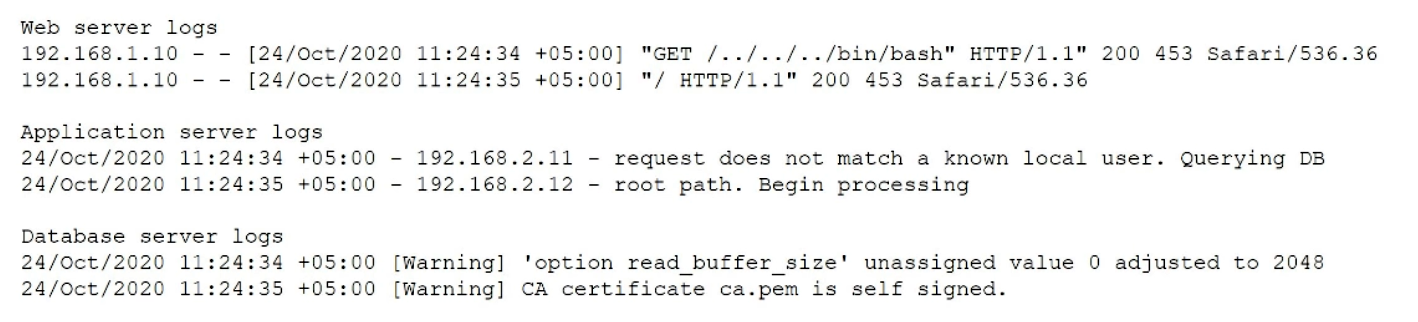
A security engineer is reviewing event logs because an employee successfully connected a personal Windows laptop to the corporate network, which is against company policy. Company policy allows all Windows 10 and 11 laptops to connect to the system as long as the MDM agent installed by IT is running. Only compliant devices can connect, and the logic in the system to evaluate compliant laptops is as follows:
Which of the following most likely occurred when the employee connected a personally owned Windows laptop and was allowed on the network?
A. The agent was not running on the laptop, which triggered a false positive.
B. The OS was a valid version, but the MDM agent was not installed, triggering a true positive.
C. The OS was running a Windows version below 10 and triggered a false negative.
D. The OS version was higher than 11, and the MDM agent was running, triggering a true negative.
Show Answer
Correct Answer: C
Explanation: The logic incorrectly returns COMPLIANT when the OS version is below 10, without checking whether the MDM agent is running. That could let a noncompliant laptop connect, so the policy violation goes undetected—a false negative.
Question 20
A security analyst is performing threat modeling for a new AI chatbot. The AI chatbot will be rolled out to help customers develop configuration information within the company's SaaS offering. Which of the following issues would require involvement from the company's internal legal team?
A. An internal user finds a way to use prompt injection to disregard guardrails.
B. A DoS vulnerability exists that could impact all customers who use the chatbot.
C. A bug bounty of an exploitable model inversion vulnerability is submitted.
D. User consent is not being collected before training models on customer data.
E. An access control issue is allowing the model to be poisoned with incorrect information.
Show Answer
Correct Answer: D
Explanation: Training models on customer data without collecting user consent raises privacy, contractual, and regulatory questions that require the internal legal team’s involvement. The other options primarily describe technical security vulnerabilities.
Question 20
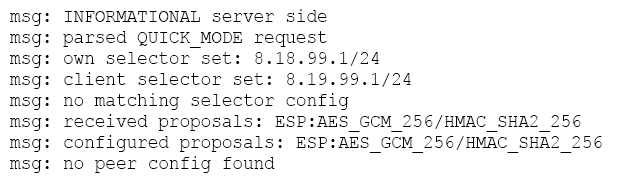
An administrator reviews the following log and determines the root cause of a site-to-site tunnel failure:
Which of the following actions should the administrator take to most effectively correct the failure?
A. Enable perfect forward secrecy on the remote peer.
B. Update the cipher suites configured for use on the server side.
C. Add a new subnet as a permitted initiator.
D. Disable IKE version 1 and run IKE version 2.
Show Answer
Correct Answer: C
Explanation: The log reports a traffic selector mismatch: the configured selector is 8.18.99.1/24, while the client requests 8.19.99.1/24, resulting in “no matching selector config.” Add the remote subnet as a permitted initiator. The ESP proposals match, so changing cipher suites or IKE version would not address the failure.
Question 21
An incident response analyst finds the following content inside of a log file that was collected from a compromised server:
Which of the following is the best action to prevent future compromise?
A. Blocking the processing of external files by forwarding them to another server for processing
B. Implementing an allow list for all text boxes throughout the web application
C. Filtering inserted characters for all user inputs and allowing only ASCII characters
D. Improving file-parsing capabilities to stop external entities from executing commands
Show Answer
Correct Answer: D
Explanation: The log indicates an XML external entity (XXE) payload attempting to access local files or invoke system-related behavior. Securely configure the XML parser to disable external entity resolution and related unsafe processing, preventing this class of attack.
Question 22
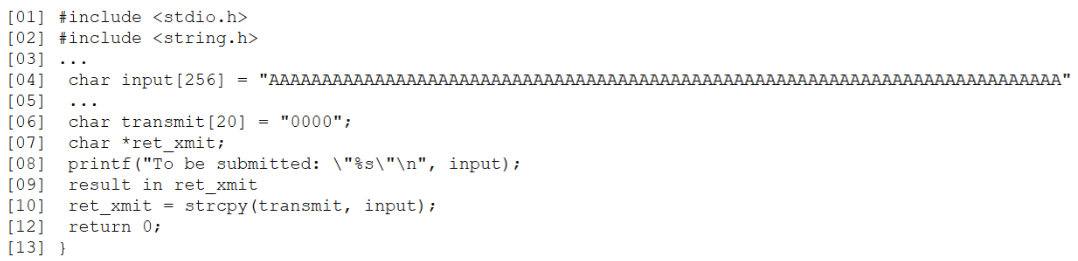
Based on the results of a SAST report on a legacy application, a security engineer is reviewing the following snippet of code flagged as vulnerable:
Which of the following is the vulnerable line of code that must be changed?
A. Line [02]
B. Line [04]
C. Line [07]
D. Line [08]
E. Line [10]
Show Answer
Correct Answer: E
Explanation: Line 10 uses `strcpy` to copy the potentially 256-byte `input` string into the 20-byte `transmit` buffer without checking its length, which can overflow the destination.
Question 23
A pharmaceutical company employs automated control systems to fabricate chemicals. During a recent experiment to attempt to secure these systems, a security engineer finds that the controllers do not appear to be sensitive to additional network latency. Which of the following is the best recommendation for this issue?
A. Performing integrity checks on control system command journals
B. Performing baseline reviews on the system configurations
C. Integrating a proxy to drop improperly formatted commands
D. Implementing in-line encryption between the control systems
E. Deploying and configuring a protocol accelerator
Show Answer
Correct Answer: C
Explanation: Because the controllers tolerate additional latency, an inline protocol-aware proxy is practical. It can inspect control-system commands and drop improperly formatted ones before they reach the controllers. Encryption would protect communications but would not validate whether commands are properly formed.
Question 23
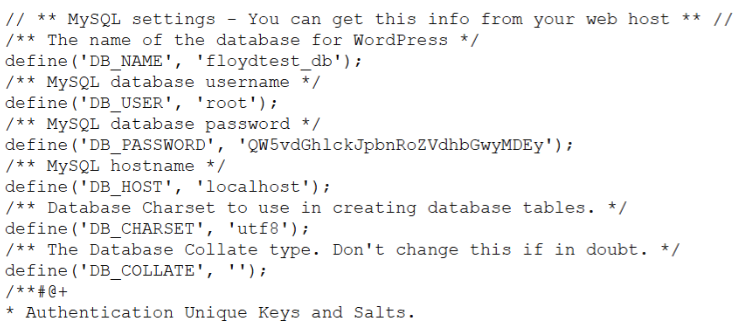
During a security review for the CI/CD process, a security engineer discovers the following information in a testing repository from the company:
Which of the following options is the best countermeasure to prevent this issue in the future?
A. Performing an application penetration test over the testing environment before moving to production
B. Changing the repository technology to avoid inclusion of confidential information
C. Automating the upload process of code to the repository and improving the software development life cycle
D. Using a secrets management platform to share and manage confidential information
Show Answer
Correct Answer: D
Explanation: The repository contains database credentials in source code. A secrets management platform keeps confidential values outside the repository and provides them securely at runtime. The exposed credentials should also be rotated.
Question 24
An auditor is reviewing the logs from a web application to determine the source of an incident. The web application architecture includes an internet-accessible application load balancer, a number of web servers in a private subnet, application servers, and one database server in a tiered configuration. The application load balancer cannot store the logs. The following are sample log snippets:
Which of the following should the auditor recommend to ensure future incidents can be traced back to the sources?
A. Enable the X-Forwarded-For header at the load balancer.
B. Install a software-based HIDS on the application servers.
C. Install a certificate signed by a trusted CA.
D. Use stored procedures on the database server.
E. Store the value of the $_SERVER['REMOTE_ADDR'] received by the web servers.
Show Answer
Correct Answer: A
Explanation: The load balancer sits between clients and the web servers, so the web servers may see the load balancer’s address as the request source. The X-Forwarded-For header carries the originating client IP through the load balancer; ensure the web-server logs record that header to support attribution. Logging `REMOTE_ADDR` alone may capture only the load balancer’s address.
Question 25
A cyber security architect seeks to improve vulnerability management and orchestrate a large number of vulnerability checks. Key constraints include:
• There are 512 containerized microservices
• Vulnerability data is sourced from multiple scanners
• CIS baselines must be enforced
• Scan activity must be scheduled.
Which of the following automation workflows best meets this objective?
A. Employing an endpoint data collection system
B. Deploying an XCCDF scanner
C. Utilizing CVSS reports for SOC analysts
D. Using a repository scanner to enforce IaC security
Show Answer
Correct Answer: B
Explanation: An XCCDF scanner can run standardized configuration checks against CIS baselines. Its scans can be scheduled across the environment; the other options do not directly provide baseline compliance checks.
Sources:
https://tech-insider.org/cis-benchmarks-server-hardening-2026
Question 25
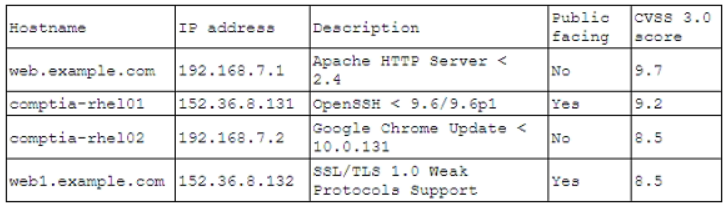
A security engineer is reviewing the following vulnerability scan report:
Which of the following should the engineer prioritize for remediation?
A. Apache HTTP Server
B. OpenSSH
C. Google Chrome
D. Migration to TLS 1.3
Show Answer
Correct Answer: B
Explanation: Prioritize the vulnerable OpenSSH service on the public-facing host. Although the Apache finding has a higher CVSS score, it is not publicly exposed; the OpenSSH issue combines a critical severity score (9.2) with direct internet exposure, increasing its immediate risk. Remediate the other findings next, based on exposure and severity.
$19
Get all 406 questions with detailed answers and explanations
Instant download HTML + PDF delivered the moment payment clears.
Secure Stripe checkout we never see or store your card details.
7-day refund if files are defective see our refund policy.