HOTSPOT
-
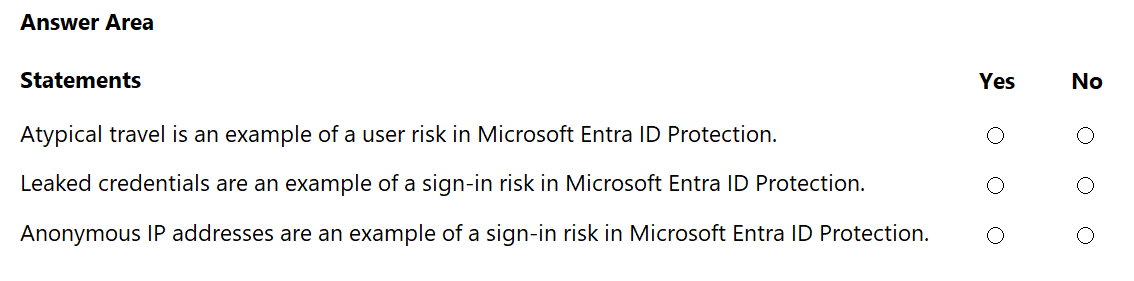
For each of the following statements, select Yes if the statement is true. Otherwise, select No.
NOTE: Each correct selection is worth one point.
Show Answer
Correct Answer: 1. No
2. No
3. Yes
Explanation: Atypical travel and anonymous IP addresses are sign-in risk detections. Leaked credentials indicate user risk, not sign-in risk.
Question 7
HOTSPOT
-
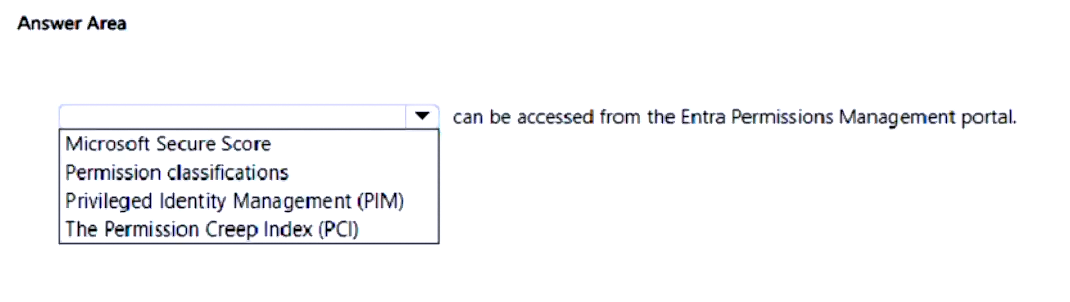
Select the answer that correctly completes the sentence.
Show Answer
Correct Answer: The Permission Creep Index (PCI)
Explanation: The Entra Permissions Management portal displays the PCI, which compares permissions granted with permissions used.
Question 8
HOTSPOT
-
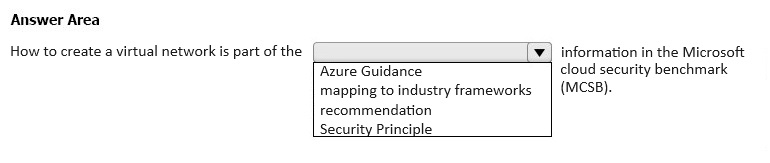
Select the answer that correctly completes the sentence.
Show Answer
Correct Answer: Azure Guidance
Explanation: The MCSB’s Azure Guidance provides implementation instructions, including how to create a virtual network.
Question 8
You are comparing features between Microsoft Defender for Office 365 Plan 1 and Plan 2.
Which feature is only available in Defender for Office 365 Plan 2?
A. Attack simulation training
B. zero-day malware detection
C. anti-phishing protection
D. volume-based attack protection
Show Answer
Correct Answer: A
Explanation: Attack simulation training is a Microsoft Defender for Office 365 Plan 2 feature. Plan 1 includes core protections such as zero-day malware detection (Safe Attachments), anti-phishing protection, and protections against bulk/high-volume email attacks, while Plan 2 adds advanced investigation, threat hunting, and attack simulation capabilities.
Question 9
HOTSPOT
-
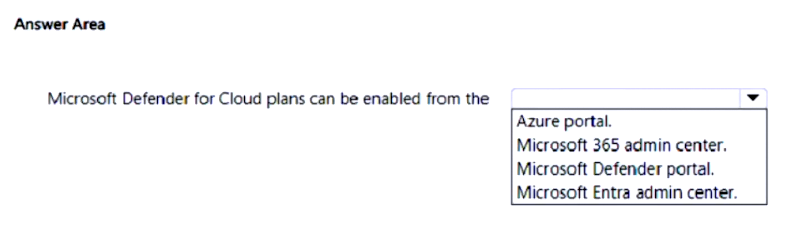
Select the answer that correctly completes the sentence.
Show Answer
Correct Answer: Azure portal.
Explanation: Microsoft Defender for Cloud plans are enabled and managed at the Azure subscription/resource level through Microsoft Defender for Cloud in the Azure portal.
Question 10
Which solution performs security assessments and automatically generates alerts when a vulnerability is found?
A. cloud security posture management (CSPM)
B. DevSecOps
C. cloud workload protection platform (CWPP)
D. security information and event management (SIEM)
Show Answer
Correct Answer: A
Explanation: Cloud security posture management (CSPM) continuously assesses cloud resources for security risks and vulnerabilities, then surfaces findings through alerts or recommendations. SIEM focuses on analyzing security events, while CWPP protects workloads.
Question 10
HOTSPOT
-
Select the answer that correctly completes the sentence.
Show Answer
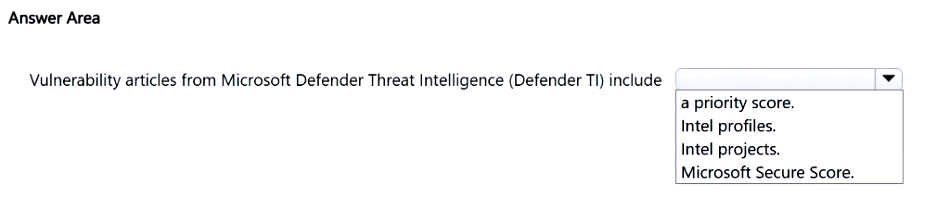
Correct Answer: a priority score.
Explanation: Defender Threat Intelligence vulnerability articles include a priority score to help assess remediation urgency. Intel profiles, Intel projects, and Microsoft Secure Score are separate features and are not included as part of vulnerability articles.
Question 11
Which Microsoft Purview feature allows users to identify content that should be protected?
A. Sensitivity Labels
B. Data loss prevention
C. eDiscovery
D. Insider Risks
Show Answer
Correct Answer: A
Explanation: Sensitivity Labels in Microsoft Purview enable users and organizations to classify and identify sensitive content that should be protected, and can apply protection such as encryption or access restrictions. Data Loss Prevention enforces policies to prevent data leakage, eDiscovery is for investigating and collecting content, and Insider Risk Management detects risky user activities.
Question 11
You have a Microsoft 365 E3 subscription.
You plan to audit user activity by using the unified audit log and Basic Audit.
For how long will the audit records be retained?
A. 15 days
B. 30 days
C. 90 days
D. 180 days
Show Answer
Correct Answer: D
Explanation: Microsoft 365 E3 uses Audit (Standard), formerly called Basic Audit. Its default retention period is 180 days for audit records generated on or after October 17, 2023. (Records generated before that date were retained for 90 days.)
Question 12
Which type of identity can be used with an Azure service and will be deleted automatically when the service is deleted?
A. user-assigned managed identity
B. service principal
C. user
D. system-assigned managed identity
Show Answer
Correct Answer: D
Explanation: A system-assigned managed identity is tied directly to the lifecycle of a single Azure resource. When the Azure service/resource is deleted, the system-assigned managed identity is automatically deleted as well. A user-assigned managed identity is a separate Azure resource that persists independently until explicitly deleted.
$19
Get all 235 questions with detailed answers and explanations
Instant download HTML + PDF delivered the moment payment clears.
Secure Stripe checkout we never see or store your card details.
7-day refund if files are defective see our refund policy.