DRAG DROP
A real-time endpoint is deployed in Azure Machine Learning to serve predictions to a web application.
Users report intermittent failures and unexpected responses when calling the endpoint.
You need to identify the appropriate troubleshooting action for each reported issue.
Which troubleshooting action should you perform for each issue? To answer, move the appropriate troubleshooting actions to the correct issues. You may use each troubleshooting action once, more than once, or not at all. You may need to move the split bar between panes or scroll to view content.
NOTE: Each correct selection is worth one point.
Show Answer
Correct Answer: Requests fail after deployment updates → Review deployment logs.
Endpoint returns incorrect results → Validate scoring script and model version.
Endpoint times out under increased traffic → Adjust autoscaling configuration.
Explanation: Logs reveal deployment errors; incorrect predictions point to the scoring code or model version; traffic-related timeouts suggest insufficient scaling.
Question 23
DRAG DROP
-
An organization is deploying generative AI solutions by using Microsoft Foundry to support multiple production workloads.
The organization has the following workload requirements:
• One workload must be real-time, latency-sensitive, and have predictable global usage patterns that demand consistent performance.
• One workload must have variable performance and be optimized for cost-efficient operation.
You need to select a global deployment type for each workload.
Which type of deployment should you use for each workload requirement? To answer, move the appropriate deployment types to the correct requirements. You may use each deployment type once, more than once, or not at all. You may need to move the split bar between panes or scroll to view content.
NOTE: Each correct selection is worth one point.
Show Answer
Correct Answer: Real-time, predictable → Global Provisioned
Flexible, cost efficient → Global Standard
Explanation: Global Provisioned reserves throughput for consistent, low-latency performance. Global Standard is pay-as-you-go and suited for variable workloads with cost optimization.
Question 23
HOTSPOT
You are monitoring a fine-tuned large language model deployed in Microsoft Foundry.
You evaluate the model before and after fine-tuning by using the same evaluation dataset.
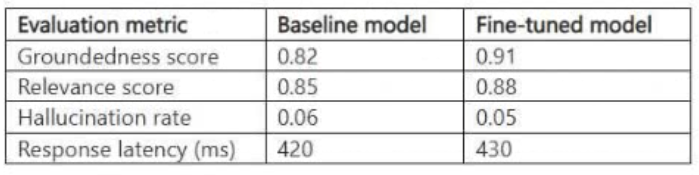
You review the following evaluation results:
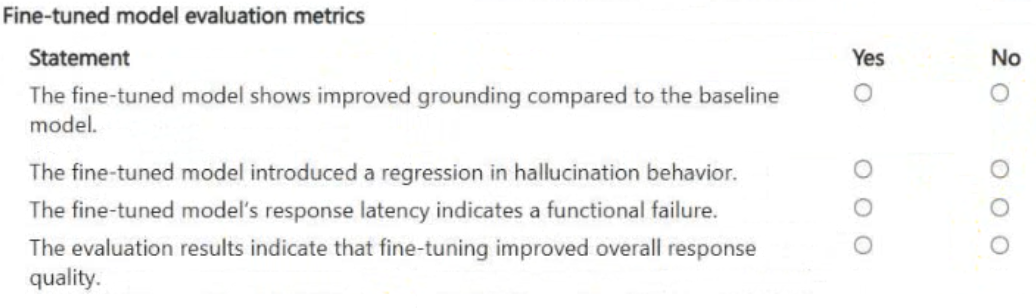
You need to determine whether the fine-tuned model shows improved performance without introducing regression. For each of the following statements, select Yes if the statement is true. Otherwise, select No.
NOTE: Each correct selection is worth one point.
Show Answer
Correct Answer: 1. Yes
2. No
3. No
4. Yes
Explanation: Groundedness and relevance increased, while the hallucination rate decreased. Latency rose slightly (420 to 430 ms), but that does not indicate a functional failure.
Question 24
A data science team plans to evaluate multiple hyperparameter values automatically while training a model in Azure Machine Learning.
The tuning process must run multiple training trials without manually modifying the training script for each run.
You need to automate hyperparameter tuning for the training job.
What should you do?
A. Run a single training job with fixed hyperparameters.
B. Adjust hyperparameters after model deployment.
C. Select hyperparameters based only on default model settings.
D. Create a tuning job that runs multiple trials with different parameter values.
Show Answer
Correct Answer: D
Explanation: Azure Machine Learning automates hyperparameter optimization by creating a tuning (sweep) job that executes multiple training trials across a defined search space without requiring manual edits to the training script for each run.
Question 24
DRAG DROP -
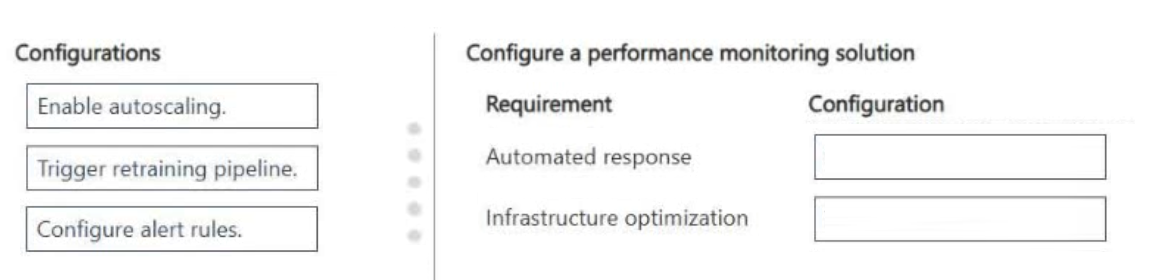
A team deploys a machine learning model to a managed online endpoint. The team monitors model performance and data quality metrics in production.
When monitoring thresholds are exceeded, the team requires an automated operational response that notifies downstream systems.
You need to configure the monitoring solution to meet the requirements.
Which configuration should you associate with each requirement as a first step? To answer, move the appropriate configurations to the correct requirements. You may use each configuration once, more than once, or not at all. You may need to move the split bar between panes or scroll to view content.
NOTE: Each correct selection is worth one point.
Explanation: Alert rules initiate notifications when monitoring thresholds are exceeded. Autoscaling adjusts endpoint capacity to match demand.
Question 25
You are authoring a notebook in Azure Machine Learning studio.
You must install packages from the notebook into the currently running kernel. The installation must be limited to the currently running kernel only.
You need to install the packages.
Which magic function should you use?
A. !pip
B. !conda
C. %load
D. %pip
Show Answer
Correct Answer: D
Explanation: Use the %pip magic command in notebooks to install packages into the currently running kernel's Python environment. Shell commands like !pip or !conda may target a different environment, while %load is for loading code, not installing packages.
Question 25
You create a binary classification model. You use the Fairlearn package to assess model fairness.
You must eliminate the need to retrain the model.
You need to implement the Fairlearn package.
Which algorithm should you use?
A. fairiearn.reductions.ExponentiatedGradient
B. fairlearn.preprocessing.CorrelationRemover
C. fairlearn.reductions.GridSearch
D. fairlearn.postprocessing.ThresholdOptimizer
Show Answer
Correct Answer: D
Explanation: Use `fairlearn.postprocessing.ThresholdOptimizer`. It applies group-specific decision thresholds to an already-trained model’s predictions, allowing fairness adjustments without retraining the model.
Question 26
HOTSPOT
-
A biomedical research company plans to enroll people in an experimental medical treatment trial.
You create and train a binary classification model to support selection and admission of patients to the trial. The model includes the following features: Age, Gender, and Ethnicity.
The model returns different performance metrics for people from different ethnic groups.
You need to use Fairlearn to mitigate and minimize disparities for each category in the Ethnicity feature.
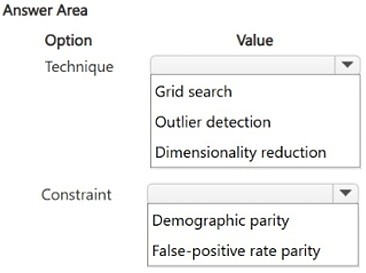
Which technique and constraint should you use? To answer, select the appropriate options in the answer area.
NOTE: Each correct selection is worth one point.
Explanation: Fairlearn mitigates group disparities using reductions such as GridSearch with fairness constraints. To reduce outcome disparities across ethnicity groups in a binary classification task, use the Demographic Parity constraint.
Question 26
A data science team trains a classification model that predicts loan approval outcomes.
Before registering the model, the team must ensure the following:
Predictions must not disproportionately impact protected groups.
Prediction errors can be evaluated across different data segments.
You need to assess whether the model meets Responsible AI expectations.
Which two approaches should you use? Each correct answer presents part of the solution. Choose two.
NOTE: Each correct selection is worth one point.
A. Analyze error rates across the global cohort.
B. Measure endpoint latency under load.
C. Validate inference schema compatibility.
D. Evaluate feature importance for prediction transparency.
E. Analyze error rates across defined demographic cohorts.
Show Answer
Correct Answer: A, E
Explanation: Compare error rates for defined demographic cohorts with the global cohort’s error rate. This reveals whether particular groups experience disproportionate errors that an overall metric alone could hide. Feature importance helps explain predictions, but it does not measure disparities in outcomes or errors.
Sources:
https://learn.microsoft.com/en-us/azure/machine-learning/concept-responsible-ai-dashboard?view=azureml-api-2
Question 27
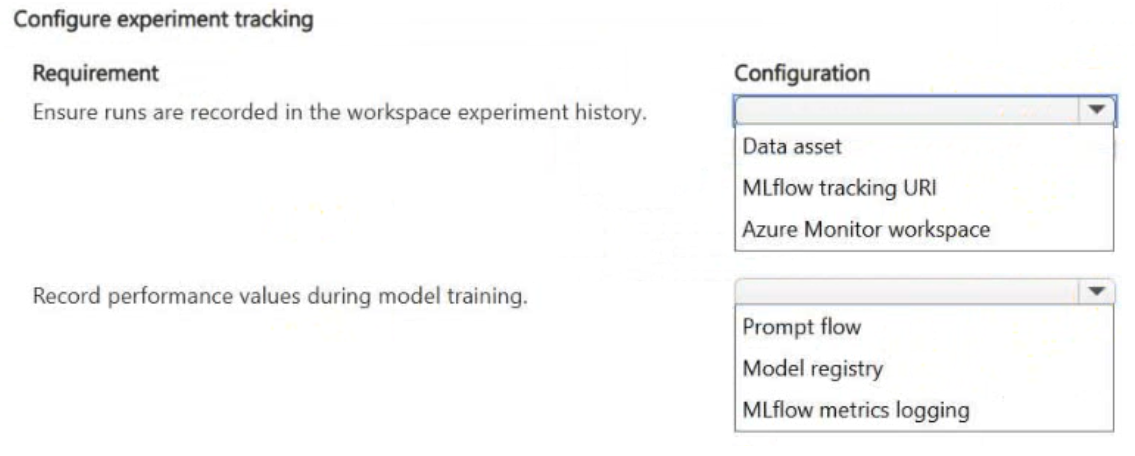
HOTSPOT -
You use Azure Machine Learning to train models across multiple experiments by using the same workspace.
You must record training runs in a centralized location to compare results from different jobs.
During training, performance values must be captured so they appear in the experiment run history.
You need to configure experiment tracking.
What should you configure for each requirement? To answer, select the appropriate options in the answer area.
NOTE: Each correct selection is worth one point.
Show Answer
Correct Answer: Ensure runs are recorded in the workspace experiment history: MLflow tracking URI
Record performance values during training: MLflow metrics logging
Explanation: The tracking URI directs runs to the Azure Machine Learning workspace. MLflow metrics logging records performance values in each run’s history.
$19
Get all 108 questions with detailed answers and explanations
Instant download HTML + PDF delivered the moment payment clears.
Secure Stripe checkout we never see or store your card details.
7-day refund if files are defective see our refund policy.