HOTSPOT -
A company is creating an internal tool that summarizes long meeting transcripts and extracts action items.
The model must:
Process text inputs up to 200k tokens long.
Generate concise summaries in seconds.
Support interactive testing before integration into the app.
You need to select, deploy, and test a model that supports summarization with low latency.
How should you complete the configuration plan? To answer, select the appropriate options in the answer area.
NOTE: Each correct selection is worth one point.
Show Answer
Correct Answer: Select a model: GPT-4.1-Mini
Select a deployment type: Serverless endpoint
Test the model: Microsoft Foundry Chat playground
Explanation: GPT-4.1-Mini supports the 200k-token input requirement and fast summarization. A serverless endpoint provides online inference, and the Chat playground supports interactive testing before integration.
Question 18
DRAG DROP
-
You use Azure Machine Learning to deploy a model as a real-time web service.
You need to create an entry script for the service that ensures that the model is loaded when the service starts and is used to score new data as it is received.
Which functions should you include in the script? To answer, drag the appropriate functions to the correct actions. Each function may be used once, more than once, or not at all. You may need to drag the split bar between panes or scroll to view content.
NOTE: Each correct selection is worth one point.
Show Answer
Correct Answer: Load the model when the service starts: init()
Use the model to score new data: run()
Explanation: In Azure Machine Learning real-time inference entry scripts, init() runs once at container startup to load the model, while run(data) is invoked for each request to perform scoring.
Question 18
A data science team trains a classification model that predicts loan approval outcomes.
Before registering the model, the team must ensure the following:
Predictions must not disproportionately impact protected groups.
Prediction errors can be evaluated across different data segments.
You need to assess whether the model meets Responsible AI expectations.
Which two approaches should you use? Each correct answer presents part of the solution. Choose two.
NOTE: Each correct selection is worth one point.
A. Analyze error rates across the global cohort.
B. Measure endpoint latency under load.
C. Validate inference schema compatibility.
D. Evaluate feature importance for prediction transparency.
E. Analyze error rates across defined demographic cohorts.
Show Answer
Correct Answer: A, E
Explanation: Compare error rates for the overall cohort with error rates for defined demographic cohorts. The overall cohort provides a baseline, while cohort-level analysis can reveal whether errors are disproportionately high for protected groups or other segments. Feature importance supports interpretability but does not assess those error disparities.
Question 19
A team is validating a generative AI assistant for a company. The assistant generates responses by using internal knowledge sources.
The company requires assurance that responses are accurate, supported by sources, and related to the user prompts before enabling production access.
You need to implement quality metrics that confirm the assistant produces reliable and meaningful responses.
Which two evaluation metrics should you use? Each correct answer presents part of the solution.
NOTE: Each correct selection is worth one point.
A. Groundedness
B. Relevance
C. Harmfulness
D. Tone
E. Fairness
Show Answer
Correct Answer: A, B
Explanation: Groundedness evaluates whether responses are supported by the provided knowledge sources, helping ensure factual accuracy and traceability. Relevance evaluates whether the response appropriately addresses the user's prompt. These directly match the requirement to verify responses are accurate, source-supported, and related to the prompt. Harmfulness, Tone, and Fairness assess safety, style, or bias rather than source support and prompt alignment.
Question 19
HOTSPOT -
You train a model in Azure Machine Learning.
You plan to capture experiment details for later comparison. The training code must log parameters and metrics for each run.
You review the following training script.
You need to verify whether the training script meets the experiment tracking requirement. For each of the following statements, select Yes if the statement is true. Otherwise, select No.
NOTE: Each correct selection is worth one point.
Show Answer
Correct Answer: No
No
Yes
Explanation: The script logs the parameter, but `accuracy_score` is not imported, so it fails before logging the metric. The model’s artifact path is the literal string `"model"`, not the experiment name. `mlflow.set_experiment()` associates the run with the named experiment.
Question 20
HOTSPOT
-
You use Azure Machine Learning to implement hyperparameter tuning for an Azure ML Python SDK v2-based model training.
Training runs must terminate when the primary metric is lowered by 25 percent or more compared to the best performing run.
You need to configure an early termination policy to terminate training jobs.
Which values should you use? To answer, select the appropriate options in the answer area.
NOTE: Each correct selection is worth one point.
Explanation: Bandit stops runs that perform worse than the best run by more than a specified tolerance. A 25% performance tolerance relative to the best run is configured with slack_factor.
Question 20
HOTSPOT -
You manage an Azure Machine Learning workspace named workspace1 by using the Python SDK v2.
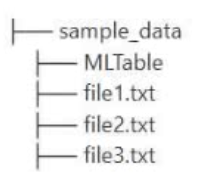
The default datastore of workspace1 contains a folder named sample_data. The folder structure contains the following content:
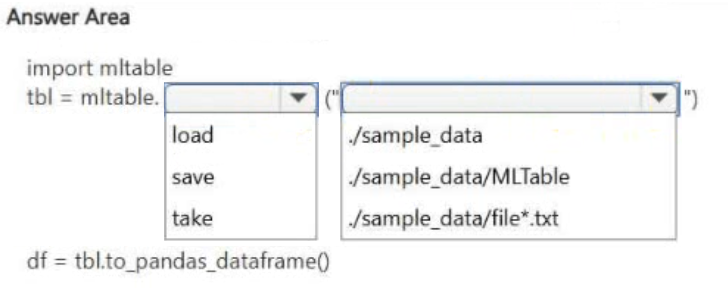
You write Python SDK v2 code to materialize the data from the files in the sample_data folder into a Pandas data frame.
You need to complete the Python SDK v2 code to use the MLTable folder as the materialization blueprint.
How should you complete the code? To answer, select the appropriate options in the answer area.
NOTE: Each correct selection is worth one point
Show Answer
Correct Answer: load
./sample_data
Explanation: mltable.load() takes the path to the folder containing the MLTable blueprint file. That file is directly inside sample_data.
Question 21
A team is experimenting with traditional models for a classification workflow in Azure Machine Learning.
The team requires a consistent way to manage assets that are created during experimentation.
You need to ensure that artifacts can be reused and governed across projects.
Which asset should you register?
A. Model
B. Component
C. Environment
D. Pipeline
Show Answer
Correct Answer: A
Explanation: Register the trained model. Azure Machine Learning model assets can be versioned and governed, making them reusable across projects. Components represent reusable workflow steps, not the trained classification artifact.
Question 22
You create an Azure Machine Learning workspace. You train an MLflow-formatted regression model by using tabular structured data.
You must use a Responsible AI dashboard to assess the model.
You need to use the Azure Machine Learning studio UI to generate the Responsible AI dashboard.
What should you do first?
A. Register the model with the workspace.
B. Create the model explanations.
C. Convert the model from the MLflow format to a custom format.
D. Deploy the model to a managed online endpoint.
Show Answer
Correct Answer: A
Explanation: To generate a Responsible AI dashboard in Azure Machine Learning studio, the model must first be available as a registered model in the workspace. The dashboard creation workflow uses the registered model and data to compute analyses such as explanations. Converting an MLflow model is unnecessary, and deployment is not required to create the dashboard.
Question 23
DRAG DROP
-
An organization is deploying generative AI solutions by using Microsoft Foundry to support multiple production workloads.
The organization has the following workload requirements:
• One workload must be real-time, latency-sensitive, and have predictable global usage patterns that demand consistent performance.
• One workload must have variable performance and be optimized for cost-efficient operation.
You need to select a global deployment type for each workload.
Which type of deployment should you use for each workload requirement? To answer, move the appropriate deployment types to the correct requirements. You may use each deployment type once, more than once, or not at all. You may need to move the split bar between panes or scroll to view content.
NOTE: Each correct selection is worth one point.
Show Answer
Correct Answer: Real-time, predictable → Global Provisioned
Flexible, cost efficient → Global Standard
Explanation: Global Provisioned reserves throughput for consistent, low-latency performance. Global Standard is pay-as-you-go and suited for variable workloads with cost optimization.
$19
Get all 96 questions with detailed answers and explanations
Instant download HTML + PDF delivered the moment payment clears.
Secure Stripe checkout we never see or store your card details.
7-day refund if files are defective see our refund policy.