You create a workspace by using Azure Machine Learning Studio.
You must run a Python SDK v2 notebook in the workspace by using Azure Machine Learning Studio.
You need to reset the state of the notebook.
Which three actions should you use? Each correct answer presents a complete solution.
NOTE: Each correct selection is worth one point.
A. Navigate to another section of the workspace.
B. stop the current kernel.
C. Reset the compute.
D. Change the current kernel.
E. Change the compute.
Show Answer
Correct Answer: C, D, E
Explanation: Reset the compute, change the kernel, or change the compute to start a fresh notebook execution context and clear its in-memory state. Navigating to another workspace section does not reset the notebook, and simply stopping the current kernel is not one of the specified reset actions.
Question 13
DRAG DROP
-
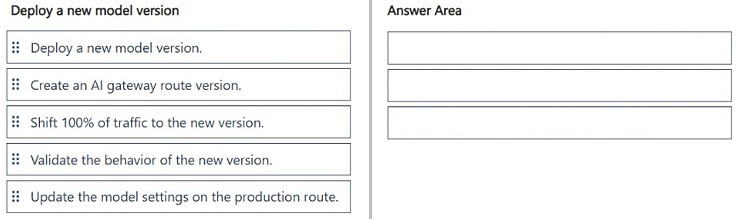
A customer-facing web application uses a foundational model deployed through Microsoft Foundry.
A new model version must be introduced and validated without disrupting production traffic.
You need to deploy the new version by using a safe promotion strategy.
Which three actions should you perform in sequence? To answer, move the appropriate actions from the list of actions to the answer area and arrange them in the correct order.
Show Answer
Correct Answer: 1. Deploy a new model version.
2. Create an AI gateway route version.
3. Validate the behavior of the new version.
Explanation: Deploy the model and test it through a separate route version while the production route continues serving the existing model. Promote only after validation.
Question 13
A team develops and manages a conversational assistant by using Microsoft Foundry.
The team requires generative AI to automatically evaluate every pull request of an agentic application and fail the build if safety thresholds are exceeded.
You need to automate evaluations as part of CI.
What should you configure?
A. Blocklist applied to the model endpoint
B. Content filter configured in warning mode
C. Retrieval chunking strategy
D. GitHub Actions workflow that executes the runs
Show Answer
Correct Answer: D
Explanation: To automate generative AI evaluations for every pull request and fail the build when safety thresholds are exceeded, configure a GitHub Actions workflow that executes the evaluation runs as part of the CI pipeline. Blocklists and content filters are runtime protections, and retrieval chunking is unrelated to CI safety gating.
Question 14
A team provisions an Azure Machine Learning environment by triggering pull requests.
Deployments must be automated, auditable, and require approval before running.
You need to select a deployment automation tool.
Which tool should you use?
A. Azure Monitor
B. GitHub Actions
C. MLflow
D. Azure Machine Learning pipelines
Show Answer
Correct Answer: B
Explanation: GitHub Actions is the appropriate CI/CD automation tool for deployments triggered by pull requests. It supports automated workflows, auditability through repository history and workflow logs, and required approval gates via protected environments before deployment. Azure Monitor is for monitoring, MLflow is for experiment/model tracking, and Azure Machine Learning pipelines orchestrate ML workflows rather than PR-based deployment approvals.
Question 14
HOTSPOT
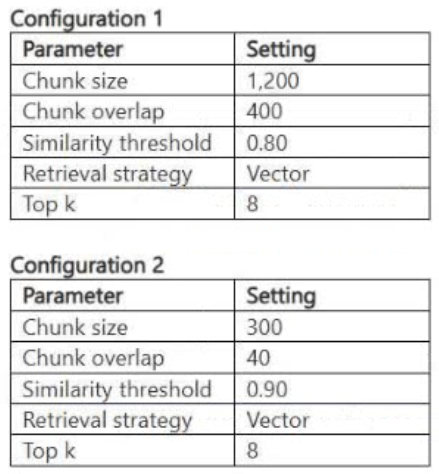
You manage a Retrieval-Augmented Generation (RAG) system that retrieves internal policy documents from a vector index.
Recent analysis shows that:
Retrieved results frequently include duplicated content from the same document.
Retrieved chunks sometimes span unrelated policy sections.
You review the following retrieval and ingestion configurations:
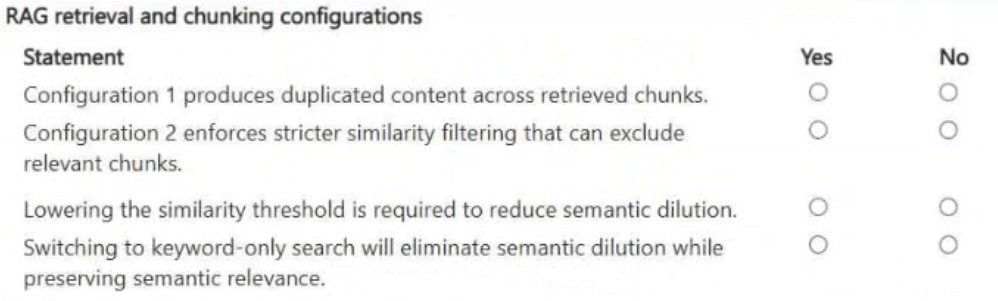
You need to reduce duplicated retrieval results and improve chunk relevance across policy sections. For each of the following statements, select Yes if the statement is true. Otherwise, select No.
NOTE: Each correct selection is worth one point.
Show Answer
Correct Answer: 1. Yes
2. Yes
3. No
4. No
Explanation: Configuration 1’s large overlap can duplicate content across retrieved chunks. Configuration 2’s higher similarity threshold can exclude relevant chunks. Semantic dilution is better addressed through more focused chunking, not a lower threshold; keyword-only search does not preserve semantic matching.
Question 15
You manage an Azure Machine Learning workspace.
You need to define an environment from a Docker image by using the Azure Machine Learning Python SDK v2.
Which parameter should you use?
A. conda_file
B. properties
C. build
D. image
Show Answer
Correct Answer: D
Explanation: In the Azure Machine Learning Python SDK v2, an Environment can be defined directly from an existing Docker image by specifying the image parameter. The conda_file parameter is for Conda dependencies layered onto a base image, build is used to build an image from a Docker build context/Dockerfile, and properties stores metadata.
Question 15
Note: This question is part of a series of questions that present the same scenario. Each question in the series contains a unique solution that might meet the stated goals. Some question sets might have more than one correct solution, while others might not have a correct solution.
After you answer a question in this section, you will NOT be able to return to it. As a result, these questions will not appear on the review screen.
You manage an Azure Machine Learning workspace. The Python script named script.py reads an argument named training_data. The training_data argument specifies the path to the training data in a file named dataset1.csv.
You plan to run the script.py Python script as a command job that trains a machine learning model.
You need to provide the command to pass the path for the dataset as a parameter value when you submit the script as a training job.
Solution: python script.py dataset1.csv
Does the solution meet the goal?
A. Yes
B. No
Show Answer
Correct Answer: B
Explanation: No. The command supplies `dataset1.csv` as a positional argument, rather than passing it by the named `training_data` parameter. Use a command such as `python script.py --training_data dataset1.csv`.
Question 16
Note: This question is part of a series of questions that present the same scenario. Each question in the series contains a unique solution that might meet the stated goals. Some question sets might have more than one correct solution, while others might not have a correct solution.
After you answer a question in this section, you will NOT be able to return to it. As a result, these questions will not appear on the review screen.
You work in Microsoft Foundry with a prompt flow.
You must manually evaluate prompts and compare results across prompt variants.
You need to capture the inputs, outputs, token usage, and latencies for each flow run for the evaluation.
Solution: In Microsoft Foundry, turn on Tracing for the prompt flow of the project and execute test runs to produce trace data.
Does the solution meet the goal?
A. Yes
B. No
Show Answer
Correct Answer: A
Explanation: Tracing records each test run’s inputs, outputs, token usage, and latency. Those records provide the data needed to manually review and compare prompt variants.
Question 16
You manage an Azure Machine Learning workspace. You have an environment for training jobs which uses an existing Docker image.
A new version of the Docker image is available.
You need to use the latest version of the Docker image for the environment configuration by using the Azure Machine Learning SDK v2.
What should you do?
A. Change the description parameter of the environment configuration.
B. Modify the conda_file to specify the new version of the Docker image.
C. Use the create_or_update method to change the tag of the image.
D. Use the Environment class to create a new version of the environment.
Show Answer
Correct Answer: D
Explanation: Azure Machine Learning environments are immutable and versioned. When the underlying Docker image changes, you define an Environment with the updated image reference and register it as a new environment version. Updating the description or conda file does not change the base image, and you do not modify an existing immutable environment in place by changing its image tag.
Question 17
You are training machine learning models in Azure Machine Learning. You use Hyperdrive to tune the hyperparameters.
In previous model training and tuning runs, many models showed similar performance.
You need to select an early termination policy that meets the following requirements:
• accounts for the performance of all previous runs when evaluating the current run
• avoids comparing the current run with only the best performing run to date
Which two early termination policies should you use? Each correct answer presents part of the solution.
NOTE: Each correct selection is worth one point.
A. Bandit
B. Default
C. Median stopping
D. Truncation selection
Show Answer
Correct Answer: C, D
Explanation: Median stopping evaluates the current run against the median performance of all running averages from previous runs at the same interval, so it considers all prior runs rather than only the best. Truncation selection cancels the lowest-performing percentage of runs at evaluation intervals based on the distribution of all runs. Bandit compares against the best-performing run, and Default applies no early termination policy.
$19
Get all 96 questions with detailed answers and explanations
Instant download HTML + PDF delivered the moment payment clears.
Secure Stripe checkout we never see or store your card details.
7-day refund if files are defective see our refund policy.