A company has a Microsoft Foundry agent that summarizes customer feedback and recommends products to customers. The agent references data from multiple knowledge sources.
Users report that the agent response time is slow.
Telemetry data shows that the agent frequently reaches its token usage limit.
You need to recommend a solution to reduce token usage without degrading the quality of the generated responses.
What should you recommend?
A. Chunk documents during indexing.
B. Reduce the number of knowledge sources used by the agent.
C. Reconfigure the prompts to limit the amount of retrieved content from the knowledge sources.
D. Lower the maximum token usage limit for the responses.
Show Answer
Correct Answer: C
Explanation: Limiting how much content the agent retrieves from its knowledge sources reduces input tokens and latency. Keeping the retrieved content focused on the most relevant information helps preserve response quality. Lowering the response limit risks truncation, while reducing knowledge sources risks omitting useful information.
Question 19
DRAG DROP
-
A company plans to implement an AI business solution for a consumer goods company.
You need to create agents that meet the following requirements:
• Orchestrate the sales order fulfillment and shipping of goods to customers.
• Analyze historical data and trends to replenish stock.
Which type of agent should you use for each requirement? To answer, drag the appropriate agent types to the correct requirements. Each agent type may be used once, more than once, or not at all. You may need to drag the split bar between panes or scroll to view content.
NOTE: Each correct selection is worth one point.
Show Answer
Correct Answer: Sales order fulfillment and shipping: Autonomous
Analyze historical data and trends to replenish stock: Task
Explanation: An autonomous agent coordinates an end-to-end fulfillment process. A task agent performs the defined analysis needed for stock replenishment.
Question 20
HOTSPOT
-
Case study
-
This is a case study. Case studies are not timed separately from other exam sections. You can use as much exam time as you would like to complete each case study. However, there might be additional case studies or other exam sections. Manage your time to ensure that you can complete all the exam sections in the time provided. Pay attention to the Exam Progress at the top of the screen so you have sufficient time to complete any exam sections that follow this case study.
To answer the case study questions, you will need to reference information that is provided in the case. Case studies and associated questions might contain exhibits or other resources that provide more information about the scenario described in the case. Information provided in an individual question does not apply to the other questions in the case study.
A Review Screen will appear at the end of this case study. From the Review Screen, you can review and change your answers before you move to the next exam section. After you leave this case study, you will NOT be able to return to it.
To start the case study
-
To display the first question in this case study, select the "Next" button. To the left of the question, a menu provides links to information such as business requirements, the existing environment, and problem statements. Please read through all this information before answering any questions. When you are ready to answer a question, select the "Question" button to return to the question.
Overview
-
Contoso, Ltd. is a high-tech manufacturing company that uses Microsoft Dynamics 365 Finance. Dynamics 365 Supply Chain Management, and Dynamics 365 Commerce for its North American operations. The company designs and develops innovative products that have many patents and proprietary technologies. The patents and engineering designs are closely guarded secrets.
Contoso executives want to integrate and adopt AI solutions to help scale the company in preparation for an anticipated period of rapid growth.
The company has multiple legal entities and Azure subscriptions that will be used in the adopted AI solutions.
Requirements
-
AI Adoption
-
The following executives will have specific responsibilities in the overall AI adoption:
• Chief Technology Officer (CTO): Select one Dynamics 365 Finance, Dynamics 365 Supply Chain Management or Dynamics 365 Commerce prebuilt AI agent and one custom Microsoft Copilot Studio AI agent to prioritize and deploy during the initial AI adoption phase.
• Chief Information Officer (CIO): Ensure that appropriate security labels are assigned to the data used by the AI agents.
• Chief Financial Officer (CFO): Analyze the return on investment (ROI) for the AI agents being deployed.
• Chief Information Security Officer (CISO): Discover and inventory AI resources for auditing.
• Chief Executive Officer (CEO): Ensure that all solutions adhere to industry-standard responsible AI practices.
All AI initiatives and agents will have a detailed business use case, a defined audience profile, and an estimated ROI that will compare the cost savings of the current process against the estimated costs of using the new AI solutions.
The company's research and development (R&D) department already has a custom Model Context Protocol (MCP) server that contains comprehensive product specifications and compliance data.
Prebuilt AI Agent
-
The CTO has NOT yet selected which prebuilt AI agent to use in Dynamics 365 Supply Chain Management. The CTO wants to view available agent templates to identify which agent will add the most business value.
Depending on which high-priority AI agents are identified, its agent capabilities must be previewed in a discovery meeting with the relevant business operation stakeholders.
Custom AI Agent
-
Contoso has identified the following custom AI agent requirements:
• The custom AI agent will use data from Dynamics 365 Supply Chain Management to answer questions for the manufacturing team as a low-code solution.
• The custom AI agent will be accessible from within Microsoft Teams.
• The custom AI agent must be designed to eventually connect to other agents that can be selected based on their description.
• The topics used in the custom AI agent will be selected based NOT on a trigger phrase, but on a description of the purpose of the query, to make the interactions more conversational.
• The custom AI agent must be able to answer questions about product specifications by using existing technologies. The product specifications are maintained by the R&D department.
• The custom AI agent must be integrated with and accessible from Dynamics 365 Supply Chain Management.
• The custom AI agent must be able to use Dynamics 365 Supply Chain Management business logic that is stored outside of the application.
Analysis, Reporting, and Troubleshooting
Contoso has identified the following analysis, reporting, and troubleshooting requirements:
• The CISO will audit all the AI solutions monthly for compliance and security.
• The CFO will analyze all the AI solutions quarterly to compare the estimated ROI against actual measured efficiencies and adoption. The CFO will use the Copilot Studio agent usage estimator to perform this analysis.
• The CISO wants to identify how much sensitive data was accessed for a given AI agent run and who accessed the data. Too much sensitive data accessed by a single user might indicate a high security risk.
• The CTO wants to track user feedback on the quality of the AI agent responses during user interactions with the agents. Consistently poor feedback will trigger an escalated reengineering discussion.
• The CEO wants a quarterly assessment of all the required metrics for their specific responsibilities. The tools used for the assessments must be Microsoft-recommended and must verify reliability, interpretability, fairness, and compliance.
• The CFO wants to identify how many interactions with the AI agents are abandoned on a given day as compared to resolved conversations. Too many abandoned sessions might indicate that Copilot Studio credits are being used inefficiently by end users.
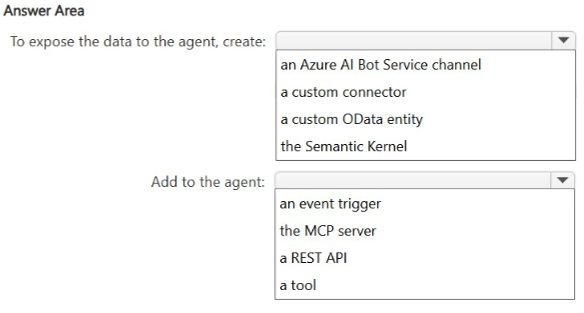
What should you include in the custom AI agent design to meet the R&D product specifications and the compliance information requirements? To answer, select the appropriate options in the answer area.
NOTE: Each correct selection is worth one point.
Show Answer
Correct Answer: To expose the data to the agent: a custom connector
Add to the agent: the MCP server
Explanation: The R&D system already exposes product specifications and compliance data through an existing MCP server. Use a custom connector to expose the external capability to Copilot Studio, then add the MCP server to the agent so it can query those resources.
Question 20
HOTSPOT
-
A company uses Microsoft Dynamics 365 Finance for accounts payable and customer debt recovery.
You are designing an AI finance process that meets the following requirements:
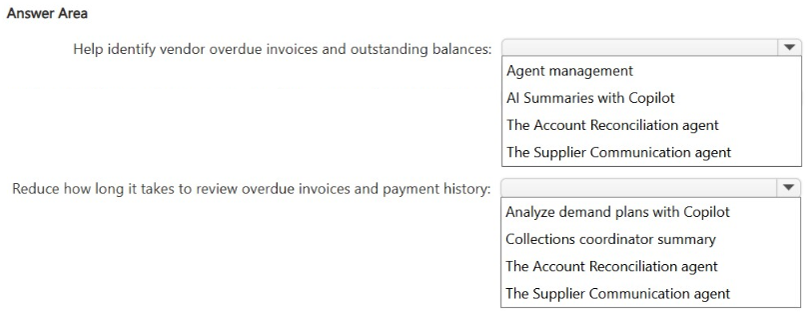
• Provides AI-driven details to help staff identify overdue vendor invoices and outstanding balances
• Helps staff reduce how long it takes to review overdue invoices and payment history
You need to recommend which Microsoft Copilot features to include in the design.
What should you recommend for each requirement? To answer, select the appropriate options in the answer area.
NOTE: Each correct selection is worth one point.
Show Answer
Correct Answer: Help identify overdue vendor invoices and outstanding balances: AI Summaries with Copilot
Reduce time reviewing overdue invoices and payment history: Collections coordinator summary
Explanation: AI Summaries with Copilot surfaces key vendor account details. The Collections coordinator summary brings together overdue invoice and payment-history information for faster debt-recovery reviews.
Question 21
A company has a Microsoft Power Platform solution that contains the following components:
• Microsoft Dataverse tables
• A Microsoft Power BI workspace named WS1
• A canvas app named App1 that uses Dataverse
• A Power BI semantic model that connects to Dataverse by using DirectQuery
You plan to use generative AI to provide answers to queries based on a subset of corporate data.
You need to ensure that the data is available as a grounding data source for AI systems.
What should you do?
A. Populate a Dataverse table.
B. Share WS1.
C. Endorse the semantic model.
D. Export the semantic model.
Show Answer
Correct Answer: C
Explanation: The relevant requirement is to make data available as a grounding source for generative AI. In Microsoft Power BI, Copilot and related AI experiences are designed to use trusted semantic models, and endorsing (Promoted or Certified) a semantic model identifies it as a curated, trusted source suitable for AI consumption. Simply sharing a workspace, exporting the model, or populating a Dataverse table does not by itself make it the intended grounding source for these AI capabilities.
Question 21
A company has an Azure environment that supports multiple business units.
The company plans to implement an AI solution that will perform sentiment analysis on customer product reviews.
You need to evaluate the potential cost of the solution to support return on AI investment (ROAI) analysis.
What should you use?
A. Cost Management + Billing
B. Microsoft Fabric SKU Estimator
C. Total Cost of Ownership (TCO) Calculator
D. Azure Reservations
Show Answer
Correct Answer: A
Explanation: Cost Management + Billing provides cost analysis, forecasts, and cost allocation across business units for the existing Azure environment. The TCO Calculator is primarily for comparing the cost of migrating existing workloads to Azure, rather than assessing a new AI solution in Azure.
Question 22
A company is designing a Microsoft Power Platform solution to reduce the manual steps of a business process by deploying an existing AI model.
You need to calculate the return on AI investment (ROAI) by identifying the metadata and telemetry of the solution.
What should you use?
A. Microsoft Power Platform admin center
B. Success by Design
C. the Business value toolkit
D. Microsoft Cloud Adoption Framework for Azure
Show Answer
Correct Answer: C
Explanation: Use the Business value toolkit. It helps capture solution metadata and telemetry and assess the business value and return on investment of Power Platform solutions, including AI investments.
Question 23
A company plans to deploy a Microsoft Foundry agent.
You need to recommend an application lifecycle management (ALM) process to ensure that the agent evaluates against baseline accuracy metrics before being deployed.
What should you recommend?
A. Configure GitHub Actions for new agent versions.
B. Deploy each new agent version directly to production.
C. Use Observability in Foundry Control Plane with evaluation and drift monitoring.
D. Enable Application Insights and use Azure Monitor.
Show Answer
Correct Answer: A
Explanation: Configure a GitHub Actions workflow to evaluate each new agent version against the baseline accuracy metrics and deploy it only if the evaluation passes. Observability and drift monitoring are useful for assessing quality, but they do not by themselves enforce a pre-deployment quality gate.
Sources:
https://learn.microsoft.com/en-us/microsoft-copilot-studio/guidance/alm#establish-a-testing-strategy
Question 24
HOTSPOT
-
A company has Microsoft Power Platform development, staging, and production environments. Each environment has its own Microsoft Dataverse tables and Azure AI Search index.
You are designing an application lifecycle management (AIM) process to deploy a Microsoft Copilot Studio agent between the environments.
The company has a Copilot Studio agent named Agent1 in development. Agent1 uses the following grounding data sources:
• A Dataverse table named CustomerOrders
• An Azure AI Search index named customer-knowledge
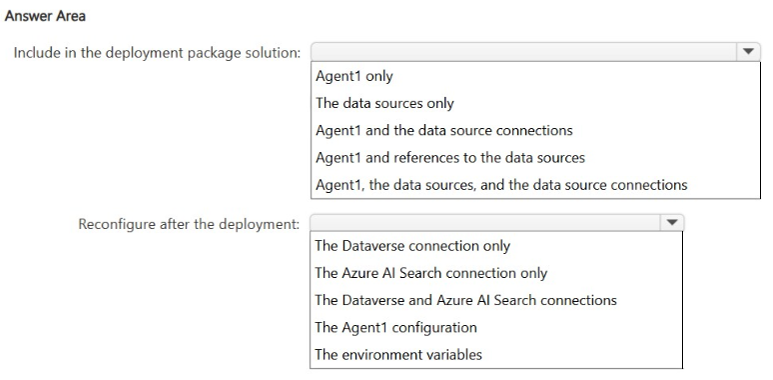
You need to deploy Agent1 to production. The solution must ensure that the agent uses the production grounding data sources, minimizes downtime, and handles credentials and endpoints securely.
What should you include in the deployment package solution, and what should you reconfigure after the deployment? To answer, select the appropriate options in the answer area.
NOTE: Each correct selection is worth one point.
Show Answer
Correct Answer: Include: Agent1 and references to the data sources
Reconfigure: The Dataverse and Azure AI Search connections
Explanation: Each environment already has its own tables and search index, so the package needs the agent and its data-source references, not copies of the data. Configure both connections after deployment to use production endpoints and credentials.
Question 25
Case study -
This is a case study. Case studies are not timed separately from other exam sections. You can use as much exam time as you would like to complete each case study. However, there might be additional case studies or other exam sections. Manage your time to ensure that you can complete all the exam sections in the time provided. Pay attention to the Exam Progress at the top of the screen so you have sufficient time to complete any exam sections that follow this case study.
To answer the case study questions, you will need to reference information that is provided in the case. Case studies and associated questions might contain exhibits or other resources that provide more information about the scenario described in the case. Information provided in an individual question does not apply to the other questions in the case study.
A Review Screen will appear at the end of this case study. From the Review Screen, you can review and change your answers before you move to the next exam section. After you leave this case study, you will NOT be able to return to it.
To start the case study -
To display the first question in this case study, select the "Next" button. To the left of the question, a menu provides links to information such as business requirements, the existing environment, and problem statements. Please read through all this information before answering any questions. When you are ready to answer a question, select the "Question" button to return to the question.
Overview -
Contoso, Ltd. is a high-tech manufacturing company that uses Microsoft Dynamics 365 Finance. Dynamics 365 Supply Chain Management, and Dynamics 365 Commerce for its North American operations. The company designs and develops innovative products that have many patents and proprietary technologies. The patents and engineering designs are closely guarded secrets.
Contoso executives want to integrate and adopt AI solutions to help scale the company in preparation for an anticipated period of rapid growth.
The company has multiple legal entities and Azure subscriptions that will be used in the adopted AI solutions.
Requirements -
AI Adoption -
The following executives will have specific responsibilities in the overall AI adoption:
• Chief Technology Officer (CTO): Select one Dynamics 365 Finance, Dynamics 365 Supply Chain Management or Dynamics 365 Commerce prebuilt AI agent and one custom Microsoft Copilot Studio AI agent to prioritize and deploy during the initial AI adoption phase.
• Chief Information Officer (CIO): Ensure that appropriate security labels are assigned to the data used by the AI agents.
• Chief Financial Officer (CFO): Analyze the return on investment (ROI) for the AI agents being deployed.
• Chief Information Security Officer (CISO): Discover and inventory AI resources for auditing.
• Chief Executive Officer (CEO): Ensure that all solutions adhere to industry-standard responsible AI practices.
All AI initiatives and agents will have a detailed business use case, a defined audience profile, and an estimated ROI that will compare the cost savings of the current process against the estimated costs of using the new AI solutions.
The company's research and development (R&D) department already has a custom Model Context Protocol (MCP) server that contains comprehensive product specifications and compliance data.
Prebuilt AI Agent -
The CTO has NOT yet selected which prebuilt AI agent to use in Dynamics 365 Supply Chain Management. The CTO wants to view available agent templates to identify which agent will add the most business value.
Depending on which high-priority AI agents are identified, its agent capabilities must be previewed in a discovery meeting with the relevant business operation stakeholders.
Custom AI Agent -
Contoso has identified the following custom AI agent requirements:
• The custom AI agent will use data from Dynamics 365 Supply Chain Management to answer questions for the manufacturing team as a low-code solution.
• The custom AI agent will be accessible from within Microsoft Teams.
• The custom AI agent must be designed to eventually connect to other agents that can be selected based on their description.
• The topics used in the custom AI agent will be selected based NOT on a trigger phrase, but on a description of the purpose of the query, to make the interactions more conversational.
• The custom AI agent must be able to answer questions about product specifications by using existing technologies. The product specifications are maintained by the R&D department.
• The custom AI agent must be integrated with and accessible from Dynamics 365 Supply Chain Management.
• The custom AI agent must be able to use Dynamics 365 Supply Chain Management business logic that is stored outside of the application.
Analysis, Reporting, and Troubleshooting
Contoso has identified the following analysis, reporting, and troubleshooting requirements:
• The CISO will audit all the AI solutions monthly for compliance and security.
• The CFO will analyze all the AI solutions quarterly to compare the estimated ROI against actual measured efficiencies and adoption. The CFO will use the Copilot Studio agent usage estimator to perform this analysis.
• The CISO wants to identify how much sensitive data was accessed for a given AI agent run and who accessed the data. Too much sensitive data accessed by a single user might indicate a high security risk.
• The CTO wants to track user feedback on the quality of the AI agent responses during user interactions with the agents. Consistently poor feedback will trigger an escalated reengineering discussion.
• The CEO wants a quarterly assessment of all the required metrics for their specific responsibilities. The tools used for the assessments must be Microsoft-recommended and must verify reliability, interpretability, fairness, and compliance.
• The CFO wants to identify how many interactions with the AI agents are abandoned on a given day as compared to resolved conversations. Too many abandoned sessions might indicate that Copilot Studio credits are being used inefficiently by end users.
Which two components in the custom AI agent design should the CFO evaluate in the quarterly agent analysis? Each correct answer presents part of the solution.
NOTE: Each correct selection is worth one point.
A. the GPT models used for the agent
B. the average characters in a chat message
C. the agent orchestration method
D. the average session time per agent
Show Answer
Correct Answer: A, C
Explanation: The CFO should evaluate the GPT models and the agent orchestration method because both are design choices that can affect how the agent handles requests and its Copilot Studio credit usage. Average message length and session time are not the relevant design components for this estimator-based analysis.
$19
Get all 119 questions with detailed answers and explanations
Instant download HTML + PDF delivered the moment payment clears.
Secure Stripe checkout we never see or store your card details.
7-day refund if files are defective see our refund policy.