You have an Azure virtual machine named VM1. A network security group (NSG) named NSG1 is linked to the network adapter of VM1.
VM1 allows inbound RDP (TCP 3389) from an on-premises network.
You need to reduce exposure on VM1. The solution must ensure that required RDP access is allowed for only a maximum of four hours.
What should you do?
A. Create a Conditional Access policy.
B. Deploy an Azure Bastion host.
C. Add a security rule to NSG1.
D. Enable just-in-time (JIT) VM access for VM1.
Show Answer
Correct Answer: D
Explanation: Enable just-in-time (JIT) VM access for VM1 and configure the allowed access duration to a maximum of four hours. JIT restricts inbound RDP access and opens the port only for the approved time window.
Question 25
HOTSPOT
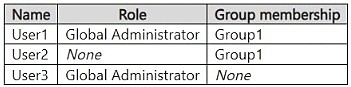
You have a Microsoft Entra tenant that contains the users shown in the following table.
The tenant contains a Conditional Access policy named CA1 that has the following settings:
• Assignments:
o Users or agents:
- Include: Directory roles: Global Administrator
• Target resources:
o Resources (formerly cloud apps):
- Include: All resources
• Conditions:
o Locations:
- Configure: Yes
- Include: Any network or location
• Access controls:
o Grant:
- Require multifactor authentication
o Grant:
- Require device to be marked as compliant
o For multiple controls:
- Require all the selected controls
The tenant contains a Conditional Access policy named CA2 that has the following settings:
• Assignments:
o Users or agents:
- Include: Users and groups: Group1
• Target resources:
o Resources (formerly cloud apps)
- Include: Select resources: Office 365
• Conditions:
o Locations:
- Configure: Yes
- Include: Any network or location
• Access controls:
o Grant:
- Require multifactor authentication
o Grant:
- Require app protection policy
o For multiple controls:
- Require one of the selected controls
The users perform the following tasks:
• User1 signs in to Microsoft 365 from a home network by using Microsoft Outlook on a noncompliant device.
• User2 signs in to Microsoft 365 without an app protection policy by using a noncompliant device.
• User3 signs in to the Azure portal from a home network by using a compliant device.
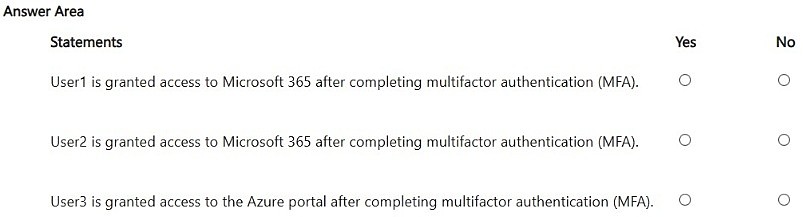
For each of the following statements, select Yes if the statement is true. Otherwise, select No.
NOTE: Each correct selection is worth one point.
Show Answer
Correct Answer: User1: No
User2: Yes
User3: Yes
Explanation: User1 must satisfy both CA1 and CA2, but the device is noncompliant, so CA1 blocks access. User2 satisfies CA2 by completing MFA; CA2 requires MFA or an app protection policy. User3 satisfies CA1 with a compliant device and MFA.
Question 25
You have a Microsoft Security Copilot workspace named Workspace1 that is used by Security Operations Center (SOC) analysts and security administrators.
The SOC analysts use only the Security Copilot standalone experience, and the security administrators access Security Copilot from the Microsoft Defender portal.
A new Security Copilot workspace named Workspace2 is created for the security administrators. Workspace2 is assigned a capacity of five security compute units.
You need to ensure that Security Copilot usage for the SOC analysts is allocated to Workspace1 and Security Copilot usage for the security administrators is allocated to Workspace2.
What should you do?
A. Configure Workspace2 for embedded agent traffic.
B. Increase the capacity of Workspace2.
C. Assign the Workspace1 capacity to Workspace2.
D. Configure Workspace1 for embedded agent traffic.
Show Answer
Correct Answer: A
Explanation: Configure Workspace2 for embedded agent traffic. The administrators’ access through the Defender portal is embedded usage, which can be routed to Workspace2. The SOC analysts’ standalone usage remains allocated to Workspace1.
Question 26
DRAG DROP
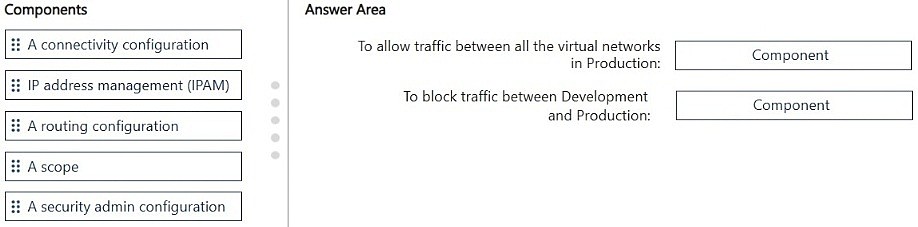
You use Azure Virtual Network Manager to manage multiple virtual networks organized into two network groups named Production and Development.
You need to configure Virtual Network Manager to meet the following requirements:
• Allow traffic between all the virtual networks in Production.
• Block traffic between Development and Production.
What should you use for each requirement? To answer, drag the components to the correct requirements. Each component may be used once, more than once, or not at all. You may need to drag the split bar between panes or scroll to view content.
NOTE: Each correct selection is worth one point.
Show Answer
Correct Answer: Allow traffic within Production: A connectivity configuration
Block traffic between Development and Production: A security admin configuration
Explanation: A connectivity configuration connects virtual networks in a network group. A security admin configuration applies rules that can deny traffic between network groups.
Question 26
DRAG DROP
You have an Azure virtual network named VNet1 that contains an AzureBastionSubnet. VNet1 contains a subnet named Subnet1. Subnet1 contains multiple virtual machines.
You plan to deploy Azure Bastion to provide secure RDP access to the virtual machines on Subnet1. You associate a network security group (NSG) named NSG1 to AzureBastionSubnet.
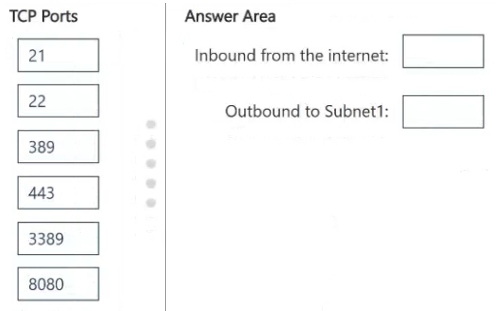
You need to configure rules for NSG1. The solution must meet the following requirements:
Allow required inbound access to Azure Bastion from the internet.
Allow user access to the virtual machines by using Azure Bastion.
Which TCP ports should you allow for the NSG1 rules? To answer, drag the appropriate ports to the correct rules. Each port may be used once, more than once, or not at all. You may need to drag the split bar between panes or scroll to view content.
NOTE: Each correct selection is worth one point.
Show Answer
Correct Answer: Inbound from the internet: TCP 443
Outbound to Subnet1: TCP 3389
Explanation: Users connect to Azure Bastion over HTTPS (443). Bastion then connects to the virtual machines over RDP (3389).
Question 27
You have an Azure subscription that contains a resource group named RG1 and has Microsoft Defender for Cloud enabled.
You connect an Amazon Web Services (AWS) account to Defender for Cloud by creating the AWS connector in RG1.
You have a Microsoft Entra group named Group1 that contains the user accounts of the security analysts at your company.
You need to ensure that the members of Group1 can view multicloud recommendations and security alerts for the connected AWS account. The solution must follow the principle of least privilege.
Which role should you assign to Group1 for RG1?
A. Security Reader
B. Reader
C. Owner
D. Security Administrator
Show Answer
Correct Answer: A
Explanation: Assign **Security Reader** to Group1 on RG1. It provides read-only access to Microsoft Defender for Cloud security information, including recommendations and alerts, without granting permissions to change settings or manage resources.
Question 27
You have a Microsoft Copilot Studio agent.
A Microsoft Power Platform administrator configures external threat detection for the agent by using a Microsoft Entra application.
You need to ensure that real-time protection is enabled during agent runtime.
What should you do in the Microsoft Defender portal?
A. Configure Microsoft Defender for Cloud Apps session policies.
B. Connect the Microsoft 365 app connector.
C. Enable Global Secure Access for Agents.
D. From Microsoft Sentinel, configure the Microsoft Purview data connector.
Show Answer
Correct Answer: B
Explanation: Connect the Microsoft 365 app connector in the Microsoft Defender portal. This enables Defender to ingest the agent activity telemetry needed for real-time protection during runtime. Session policies in Defender for Cloud Apps are not the required setup for this Copilot Studio agent protection configuration.
Question 28
HOTSPOT
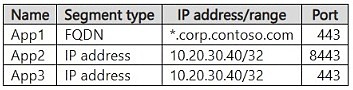
You have three on-premises apps named App1, App2, and App3 that are configured in Microsoft Entra Private Access as shown in the following table.
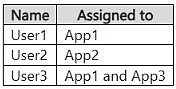
You have the users shown in the following table.
The Global Secure Access client is deployed to all user devices.
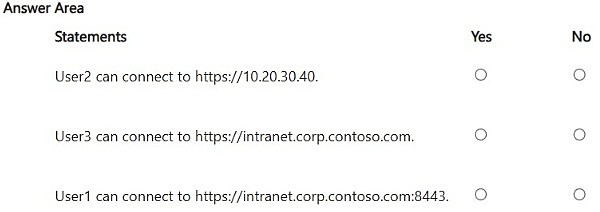
For each of the following statements, select Yes if the statement is true. Otherwise, select No.
NOTE: Each correct selection is worth one point.
Show Answer
Correct Answer: User2 can connect to https://10.20.30.40: No
User3 can connect to https://intranet.corp.contoso.com: Yes
User1 can connect to https://intranet.corp.contoso.com:8443: No
Explanation: Access requires an assigned app whose segment matches both the destination and port. User2’s IP assignment permits only port 8443. App1 covers intranet.corp.contoso.com on port 443, but not port 8443.
Question 28
Note: This section contains one or more sets of questions with the same scenario and problem. Each question presents a unique solution to the problem. You must determine whether the solution meets the stated goals. More than one solution in the set might solve the problem. It is also possible that none of the solutions in the set solve the problem.
After you answer a question in this section, you will NOT be able to return. As a result, these questions do not appear on the Review Screen.
You have a Microsoft Sentinel workspace.
You have a multi-tier Security Operations Center (SOC) team.
You need to ensure that all new security incidents are assigned immediately to the Tier 1 analysts group and flagged for triage.
Solution: You create a playbook.
Does this meet the goal?
A. Yes
B. No
Show Answer
Correct Answer: B
Explanation: No. Creating a playbook alone does not run it when a new incident is created. It must be triggered, typically by an automation rule configured to assign the incident to the Tier 1 group and add a triage flag or tag.
Question 29
Note: This section contains one or more sets of questions with the same scenario and problem. Each question presents a unique solution to the problem. You must determine whether the solution meets the stated goals. More than one solution in the set might solve the problem. It is also possible that none of the solutions in the set solve the problem.
After you answer a question in this section, you will NOT be able to return. As a result, these questions do not appear on the Review Screen.
You have a Microsoft Sentinel workspace.
You have a multi-tier Security Operations Center (SOC) team.
You need to ensure that all new security incidents are assigned immediately to the Tier 1 analysts group and flagged for triage.
Solution: You create a hunting query.
Does this meet the goal?
A. Yes
B. No
Show Answer
Correct Answer: B
Explanation: No. A hunting query is used to search security data for potential threats; it does not automatically assign new incidents or flag them. An automation rule can trigger when an incident is created and assign it to Tier 1 while adding a triage flag or tag.
$19
Get all 130 questions with detailed answers and explanations
Instant download HTML + PDF delivered the moment payment clears.
Secure Stripe checkout we never see or store your card details.
7-day refund if files are defective see our refund policy.