A retail point of sale (POS) system is an example of which type of solution?
A. a data warehouse
B. online analytical processing (OLAP)
C. extract, transform, and load (ETL)
D. online transaction processing (OLTP)
Show Answer
Correct Answer: D
Explanation: A retail point-of-sale (POS) system is an Online Transaction Processing (OLTP) system because it processes high volumes of real-time transactional operations such as sales, payments, inventory updates, and receipts. Data warehouses and OLAP are used for reporting and analytics, while ETL is the process of moving and transforming data between systems.
Question 73
HOTSPOT
-
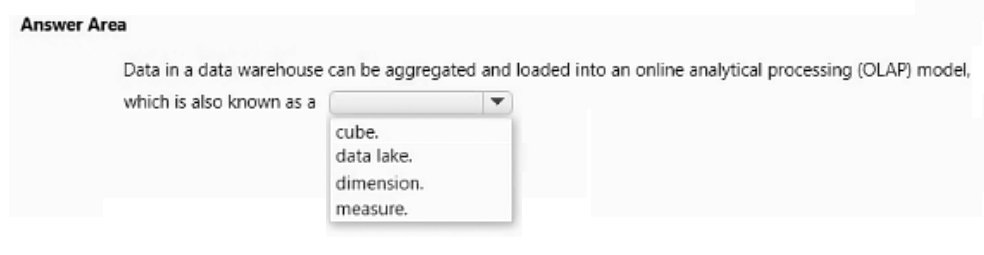
Select the answer that correctly completes the sentence.
Show Answer
Correct Answer: cube
Explanation: An OLAP (Online Analytical Processing) model is commonly referred to as an OLAP cube, which stores aggregated multidimensional data for analysis.
Question 74
DRAG DROP
-
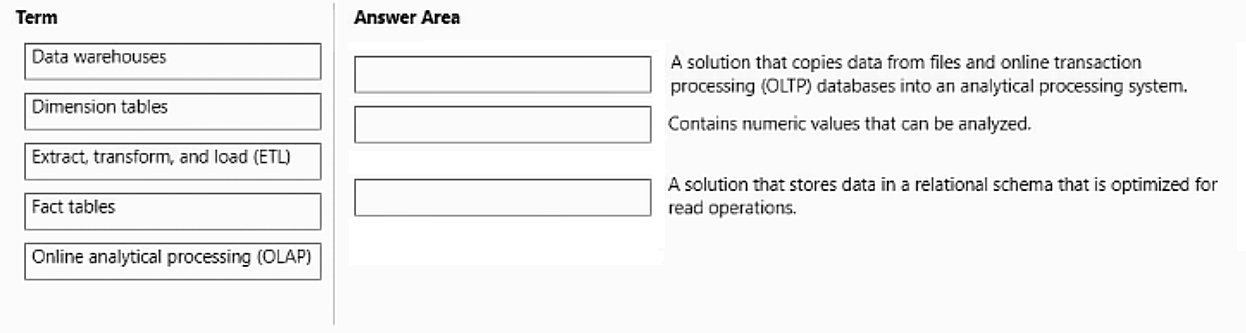
Match the terms to the appropriate descriptions.
To answer, drag the appropriate term from the column on the left to its description on the right. Each term may be used once, more than once, or not at all.
NOTE: Each correct match is worth one point.
Show Answer
Correct Answer: Extract, transform, and load (ETL)
Fact tables
Data warehouses
Explanation: ETL copies and prepares data from OLTP/files into analytical systems. Fact tables store measurable numeric values. Data warehouses are relational stores optimized for analytical read operations.
Question 75
HOTSPOT
-
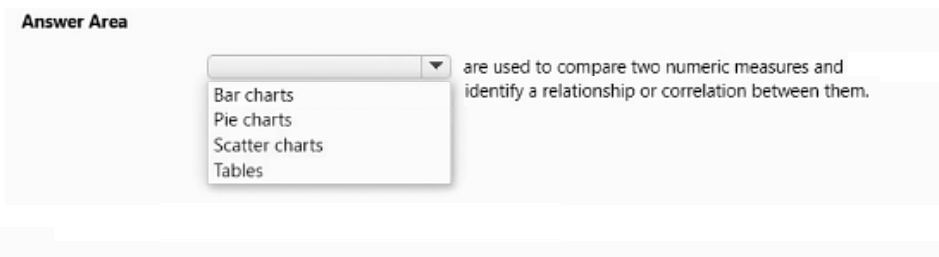
Select the answer that correctly completes the sentence.
Show Answer
Correct Answer: Scatter charts
Explanation: Scatter charts compare two numeric variables and help identify relationships or correlations between them.
Question 76
Which file format has defined names and data types for each column and uses compressed columnar storage?
A. HTML
B. CSV
C. Apache Parquet
D. JSON
Show Answer
Correct Answer: C
Explanation: Apache Parquet is a columnar storage file format that stores schema metadata including column names and data types, and uses compressed columnar storage for efficient analytics. HTML, CSV, and JSON do not provide this combination of typed schema and compressed columnar storage.
Sources:
https://learn.microsoft.com/en-us/answers/questions/381106/parquet-in-data-lake-vs-csv-file
https://learn.microsoft.com/en-us/azure/synapse-analytics/sql/query-data-storage
Question 77
HOTSPOT
-
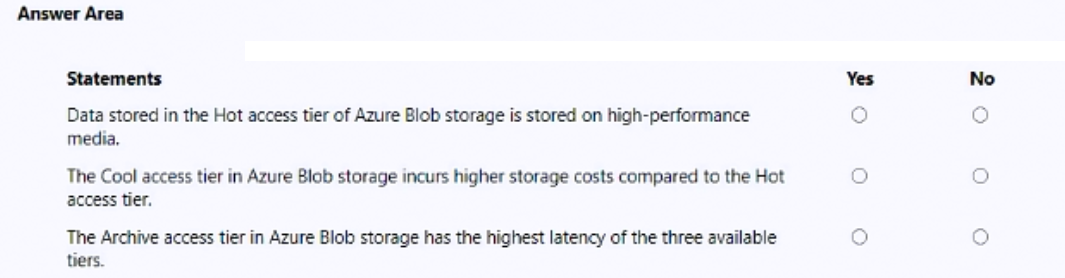
For each of the following statements, select Yes if the statement is true. Otherwise, select No.
NOTE: Each correct selection is worth one point.
Show Answer
Correct Answer: Yes
No
Yes
Explanation: Hot tier is optimized for frequent access and high-performance media. Cool tier has lower storage cost than Hot (but higher access costs). Archive is offline and has the highest retrieval latency.
Question 78
A data engineer is responsible for which task?
A. Explore data to identify trends.
B. Implement policies, tools, and processes for backup and recovery plans.
C. Design and build analytical models.
D. Design and implement data stores for analytical workloads.
Show Answer
Correct Answer: D
Explanation: A data engineer is responsible for designing and implementing data platforms and data stores that support analytical workloads, including ingestion, transformation, and storage. Exploring trends is typically a data analyst task, backup and recovery policies are generally handled by database administrators, and designing analytical models is more aligned with data scientists or analysts.
Question 79
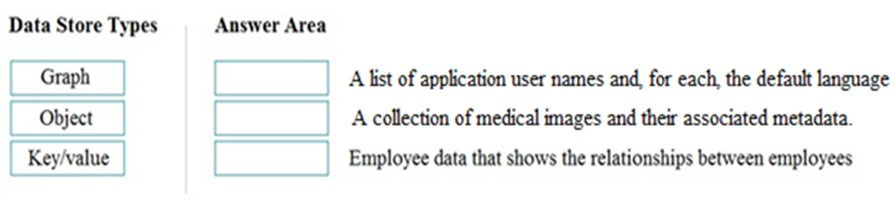
DRAG DROP -
Match the types of data stores to the appropriate scenarios.
To answer, drag the appropriate data store type from the column on the left to its scenario on the right. Each data store type may be used once, more than once, or not at all.
NOTE: Each correct match is worth one point.
Select and Place:
Show Answer
Correct Answer: Key/value
Object
Graph
Explanation: Key/value stores efficiently map usernames to a single attribute such as default language. Object storage is ideal for large binary files like medical images with metadata. Graph databases model relationships, such as reporting or collaboration between employees.
Question 80
What is a characteristic of non-relational data?
A. no indexes
B. self-describing entities
C. a well-defined schema
D. no unique key values
Show Answer
Correct Answer: B
Explanation: Non-relational (NoSQL) data is typically schema-flexible, with entities that are self-describing (for example, documents containing their own fields). Non-relational databases can support indexes and unique keys, so A and D are incorrect. A well-defined fixed schema is a characteristic of relational databases, making C incorrect.
Question 81
You need to store event log data that is semi-structured and received as the logs occur.
What should you use?
A. Azure Table storage
B. Azure Queue storage
C. Azure Files
Show Answer
Correct Answer: A
Explanation: Azure Table storage is the best fit among the given options for storing large volumes of semi-structured event log data. It is a NoSQL key-value store designed for structured and semi-structured data. Azure Queue storage is intended for transient messaging between application components, not long-term log storage, and Azure Files is for managed file shares rather than scalable semi-structured data storage.
$19
Get all 284 questions with detailed answers and explanations
Instant download HTML + PDF delivered the moment payment clears.
Secure Stripe checkout we never see or store your card details.
7-day refund if files are defective see our refund policy.