You have an Azure subscription that contains an Azure Cosmos DB for NoSQL account named account1.
Backups for account1 have the following configurations:
• Interval: 2 hours
• Retention period: 4 days
You need to estimate the charges associated with the retention of the backups.
How many copies of the backups will incur additional charges?
A. 8
B. 12
C. 46
D. 48
Show Answer
Correct Answer: C
Explanation: A 2-hour interval over 4 days results in 48 backup copies (12 per day × 4 days). Two copies are included at no additional charge, so 46 copies incur additional charges.
Question 62
HOTSPOT
You have an Azure subscription that contains a resource group named RG1. RG1 contains an Azure Cosmos DB for NoSQL account named account1.
You plan to audit changes to the control plane of account1.
You need to ensure that audit events include the details of the security principal that performs each control plane change.
How should you complete the az command? To answer, select the appropriate options in the answer area.
NOTE: Each correct selection is worth one point.
Explanation: Disabling key-based metadata writes requires control-plane changes to use an identifiable security principal, so audit events can include its details.
Question 63
You are creating an Azure Cosmos DB for NoSQL account.
You need to choose whether to configure capacity by using either provisioned throughput or serverless mode.
Which two workload characteristics cause you to choose serverless mode? Each correct answer presents part of the solution.
NOTE: Each correct selection is worth one point.
A. geo-distribution requirements
B. low average-to-peak traffic ratio
C. 25 TB of data in a single container
D. high average-to-peak traffic ratio
E. intermittent traffic
Show Answer
Correct Answer: B, E
Explanation: Serverless is suited to workloads with a low average-to-peak traffic ratio and intermittent usage. You pay for consumed request units, so it avoids paying for provisioned capacity during periods of low or no activity.
Question 64
HOTSPOT
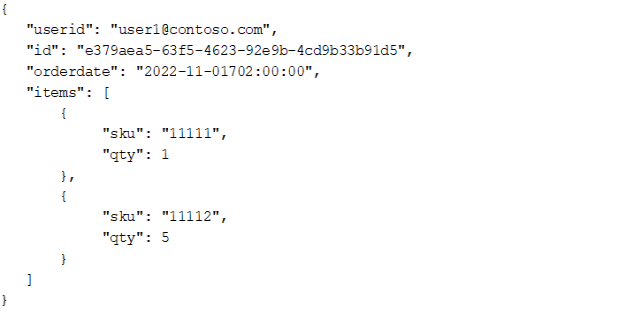
You plan to create an Azure Cosmos DB for NoSQL container that will contain items in the following format.
You need to define a query that will return the userid values of all the users who purchased an item that has a sku value of 11111.
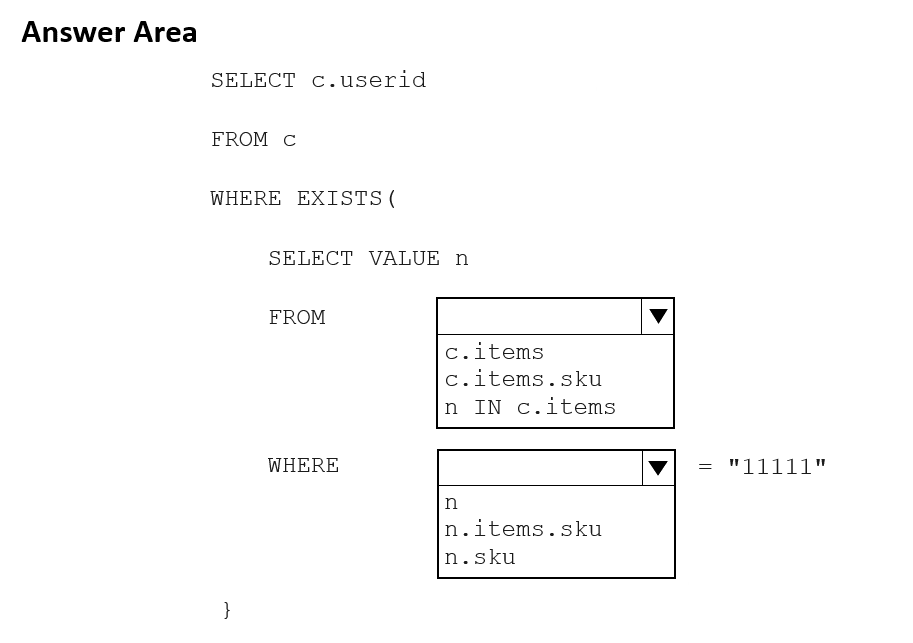
How should you compete the query? To answer, select the appropriate options in the answer area.
NOTE: Each correct selection is worth one point.
Show Answer
Correct Answer: FROM: n IN c.items
WHERE: n.sku
Explanation: The subquery iterates over the items array as n and checks each item's sku. EXISTS is true when at least one item has sku "11111".
Question 65
HOTSPOT
You have a container named container1 in an Azure Cosmos DB Core (SQL) API account.
The following is a sample of a document in container1.
[sampleXML/xmlfile-102_1.png]
The container1 container has the following indexing policy.
[sampleXML/xmlfile-103_1.png]
For each of the following statements, select Yes if the statement is true. Otherwise, select No.
NOTE: Each correct selection is worth one point.
Hot Area:
[sampleXML/xmlfile-104_1.png]
Show Answer
Correct Answer: Yes
Yes
Yes
Explanation: The indexing policy applies to the document’s properties by their exact paths. A differently spelled property name does not match an excluded path, so it remains indexed.
Question 66
You provision an Azure Cosmos DB for NoSQL container. You set the throughput to Autoscale, and the maximum request units per second (RU/s) to 20,000.
For how many RU/s will you be charged when the actual RU/s usage is zero?
A. 0
B. 200
C. 2,000
D. 4,000
E. 10,000
Show Answer
Correct Answer: C
Explanation: Autoscale charges for at least 10% of the configured maximum throughput. Ten percent of 20,000 RU/s is 2,000 RU/s, even when actual usage is zero.
Question 67
You have a container in an Azure Cosmos DB for NoSQL account.
You need to create an alert based on a custom Log Analytics query.
Which signal type should you use?
A. Log
B. Metrics
C. Activity Log
D. Resource Health
Show Answer
Correct Answer: A
Explanation: A custom Log Analytics query uses the Log signal type. Metrics, Activity Log, and Resource Health are different alert signal types.
Question 68
HOTSPOT
You have an Azure Cosmos DB for NoSQL account.
You plan to create a container named container1. The container1 container will store items that include two properties named name and age.
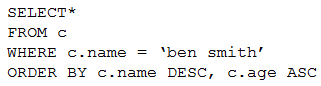
The most commonly executed queries will query container1 for a specific name. The following is a sample of the query.
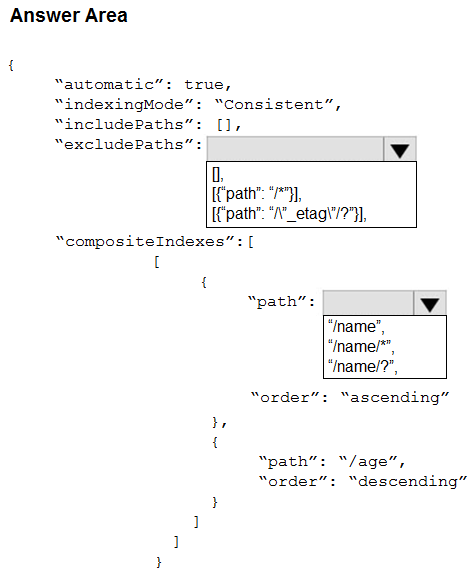
You need to define an opt-in indexing policy for container1. The solution must meet the following requirements:
• Minimize the number of request units consumed by the queries.
• Ensure that the _etag property is excluded from indexing.
How should you define the indexing policy? To answer, select the appropriate options in the answer area.
NOTE: Each correct selection is worth one point.
Show Answer
Correct Answer: excludedPaths: [{"path":"/*"}]
Composite index path: "/name"
Explanation: Excluding /* makes the policy opt-in and keeps _etag unindexed. The composite index supports the query’s ORDER BY because its ascending-name, descending-age order can be scanned in reverse.
Question 69
You have an Azure Cosmos DB for NoSQL account.
You configure the diagnostic settings to send all log information to a Log Analytics workspace.
You need to identify when the provisioned request units per second (RU/s) for resources within the account were modified.
You write the following query.
AzureDiagnostics
| where Category == "ControlPlaneRequests"
What should you include in the query?
A. | where OperationName startswith "RegionAddComplete"
B. | where OperationName startswith "SqlContainersCreate"
C. | where OperationName startswith "MongoCollectionsThroughputUpdate"
D. | where OperationName startswith "SqlContainersThroughputUpdate"
Show Answer
Correct Answer: D
Explanation: For Azure Cosmos DB for NoSQL, changes to a SQL container’s provisioned throughput are recorded as control-plane operations whose OperationName starts with `SqlContainersThroughputUpdate`.
Question 70
DRAG DROP
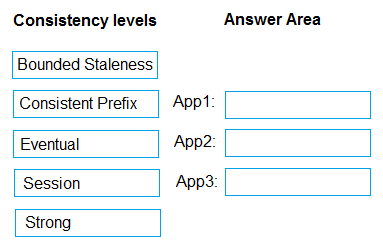
You are designing three apps named App1, App2, and App3. Each app will use a separate Azure Cosmos DB for NoSQL account. The apps have the following consistency requirements:
• App1: Reads must always return the most recent committed version of an item, where the commit occurred during the same session.
• App2: Reads must always return the most recent committed version of an item, even if the commit occurred during another session.
• App3: Write latency must be minimized and data staleness can be tolerated.
You need to recommend a default consistency level for each Azure Cosmos DB for NoSQL account. The solution must minimize concurrency.
What should you recommend for the account of each app? To answer, drag the appropriate consistency levels to the correct apps. Each consistency level may be used once, more than once, or not at all. You may need to drag the split bar between panes or scroll to view content.
NOTE: Each correct selection is worth one point.
Explanation: Session consistency provides the latest committed version within the same session. Strong consistency provides the latest committed version across sessions. Eventual consistency minimizes write latency when stale reads are acceptable.
$19
Get all 177 questions with detailed answers and explanations
Instant download HTML + PDF delivered the moment payment clears.
Secure Stripe checkout we never see or store your card details.
7-day refund if files are defective see our refund policy.