This is the free Microsoft AB-620 practice question bank —
30 of 49 total questions, each with a full explanation, free to
read with no signup required. Updated 2026-11-12.
Every answer is verified against official Microsoft documentation —
see our methodology.
Question 1
Case Study
This is a case study. Case studies are not timed separately from other exam sections. You can use as much exam time as you would like to complete each case study. However, there might be additional case studies or other exam sections. Manage your time to ensure that you can complete all the exam sections in the time provided. Pay attention to the Exam Progress at the top of the screen so you have sufficient time to complete any exam sections that follow this case study.
To answer the case study questions, you will need to reference information that is provided in the case. Case studies and associated questions might contain exhibits or other resources that provide more information about the scenario described in the case. Information provided in an individual question does not apply to the other questions in the case study.
A Review Screen will appear at the end of this case study. From the Review Screen, you can review and change your answers before you move to the next exam section. After you leave this case study, you will NOT be able to return to it.
To start the case study
To display the first question in this case study, select the "Next" button. To the left of the question, a menu provides links to information such as business requirements, the existing environment, and problem statements. Please read through all this information before answering any questions. When you are ready to answer a question, select the "Question" button to return to the question.
Background
Fabrikam Inc. is a Canada-based manufacturer with a growing service organization that supports field technicians and internal operations teams. Fabrikam Inc. plans to launch a new internal agent solution named Operations Concierge to reduce time spent searching policy content, retrieving operational metrics, and executing routine transactions.
The agent will be used by three groups:
• Service coordinators who triage incoming service requests
• Field technicians who need guided procedures and parts availability
• Operations managers who monitor KPIs and exceptions
The agent solution must work in real-world operational conditions. Users often ask questions mid-call with a customer or while coordinating parts shipments. The agents require quick, reliable outcomes. As a result, Fabrikam Inc. requires the solution to:
• Provide grounded answers with traceability when it provides guidance.
• Retrieve real-time metrics when users ask for operational status.
• Execute authenticated updates when users initiate a flow (such as creating a parts request).
Fabrikam Inc. also expects the solution to be maintained by multiple makers and developers across the year. The company has experienced duplicated logic and inconsistent behavior across different agents. This project emphasizes reuse, governance, and maintainability across teams.
Current environment
Fabrikam Inc. runs three Microsoft Power Platform environments for agent development and release: Dev, Test, and Prod.
The team plans to build the agent and validate it in Dev and Test, then promote to Prod by using a controlled release process that supports repeatable deployments.
Fabrikam Inc. already has two assets the team wants to reuse:
• A partially completed Copilot Studio agent named Service Desk Agent, used by IT to create internal tickets and route requests
• A Microsoft Foundry agent created by a central AI team that performs specialized summarization and classification for long-form text (for example, summarizing call transcripts into an incident narrative)
Fabrikam Inc. also has operational and knowledge data sources:
• A curated policy library (internal SOPs, service warranty rules, escalation criteria, and standard operating procedures)
• A set of indexed documents and procedures in an Azure AI Search service that supports vector search for the policy library
• A Microsoft Fabric workspace that includes a semantic model used by operations leadership for reporting
Business requirements
Fabrikam Inc. requires Operations Concierge to meet the following business requirements:
• Traceability requirement: When the agent provides policy guidance or procedural recommendations, users must be able to see where the answer came from.
• Metrics requirement: When users ask about service performance (backlog, SLA risk, parts shortages, dispatch delays), the solution must return up-to-date metrics in a structured format that operations managers can use in weekly reviews.
• Transaction requirement: The solution must support authenticated updates initiated during conversations, including creating a parts request and updating a service case status.
In addition, Fabrikam Inc. wants to avoid duplicating common assets across agents:
• The team must reuse the same set of escalation topics, MCP tool definitions, and a standard safety disclaimer across three different agents.
• Only the platform engineering group as allowed to edit shared assets. However, all agent authors must be able to use them.
Technical requirements
The Fabrikam Inc. solution architecture uses a multi-agent approach so that specialist responsibilities are isolated and can evolve independently.
The Operations Concierge (primary agent) must coordinate the following specialist capabilities:
• Policy and procedure Q&A: Use an enterprise knowledge source that supports indexed retrieval across the curated policy library and service procedures.
• Operational metrics: Delegate metric queries to a Fabric Data Agent that reads governed business data through the Fabric semantic model.
• Authenticated updates: Use tools exposed by an existing internal Model Context Protocol (MCP) server that provides transactional operations for the service organization.
• Specialized processing: Delegate summarization and classification requests to an existing Microsoft Foundry agent.
Fabrikam Inc. will onboard two MCP servers as tools:
• PartsOps MCP server: exposes tools for parts availability checks and parts request creation. The server requires per-user authentication because actions must be traceable to the requesting user.
• WarrantyRules MCP server: exposes a read-only tool for validating warranty coverage. The server uses an API key shared by the agent team.
Fabrikam Inc. has also defined a collaboration requirement with the existing Service Desk Agent:
• The primary agent must delegate IT-specific requests to the existing Service Desk Agent rather than reimplement ticket creation logic.
Finally, Fabrikam Inc. plans to support a partner integration:
• For shipment tracking inquiries, Fabrikam Inc. will delegate to a partner-provided agent that is only available through a standardized agent-to-agent endpoint.
Issues and constraints
During early testing, Fabrikam Inc. found three recurring problems:
• Makers are copying and modifying the same components across agents, resulting in inconsistent disclaimers and duplicated tools.
• Users can obtain a correct answer, but the response is not consistently traceable to a source when the agent uses knowledge.
• The primary agent can route some requests, but specialist capabilities are not consistently delegated (for example, some metric questions are answered generatively instead of being routed to the Fabric Data Agent).
You are part of the engineering team responsible for correcting the design and configuration to meet the preceding requirements and constraints.
You need to enable collaboration requirements for Operations Concierge.
Which two actions should you perform? Each correct answer presents part of the solution.
NOTE: Each correct selection is worth one point.
A. Enable allow connections from other agents on the Service Desk Agent.
B. Replace the Service Desk Agent with an MCP server.
C. Publish Operations Concierge to enable delegation automatically.
D. Add the Service Desk Agent as an indexed knowledge source.
E. Publish the Service Desk Agent.
Show Answer
Correct Answer: A, E
Explanation: Enable connections from other agents on the Service Desk Agent, then publish it. This allows Operations Concierge to delegate IT-specific requests to the existing agent. Publishing Operations Concierge does not automatically enable delegation, and adding the Service Desk Agent as a knowledge source would not provide agent-to-agent task delegation.
Question 2
DRAG DROP
A company uses a supported Power Platform connector to provide real-time access to enterprise records for knowledge grounding in an agent in Copilot Studio.
To meet the business needs, the knowledge source must provide the following functionality:
• Avoid copying enterprise data into an index.
• Keep source-system access controls enforced.
• Access data by calling the system at runtime.
You need to configure the connector knowledge source.
What should you configure for each requirement? To answer, move the appropriate configurations to the correct requirements. You may use each configuration once, more than once, or not at all. You may need to move the split bar between panes or scroll to view content.
NOTE: Each correct selection is worth one point.
Show Answer
Correct Answer: Avoid copying enterprise data into an index → Retrieve data without indexing.
Keep source-system access controls enforced → Use existing permissions.
Access data by calling the system at runtime → Use real-time connector.
Explanation: These settings retrieve records on demand without creating an index, retain the source system’s permissions, and query the system at runtime.
Question 3
DRAG DROP
A solution containing an agent in Copilot Studio is deployed to multiple environments that require different configuration values.
Configuration values must vary by environment without modifying the solution contents.
Configuration values must meet the following requirements:
• Allow values to be set during import.
• Exclude values from the agent definition.
• Run a dedicated agent instance for each individual environment.
You need to associate each requirement with the configuration approach.
What should you configure for each requirement? To answer, move the appropriate configurations to the correct requirements. You may use each configuration once, more than once, or not at all. You may need to move the split bar between panes or scroll to view content.
NOTE: Each correct selection is worth one point.
Show Answer
Correct Answer: Allow values to be set during import → Define environment variables in the solution.
Exclude values from the agent definition → Define environment variables in the solution.
Run a dedicated agent instance for each environment → Publish distinct agent versions for each environment.
Explanation: Environment variables keep configuration outside the agent definition and can receive environment-specific values during solution import. Publishing an agent separately in each environment provides a dedicated instance.
Question 4
A tenant administrator configures a Copilot connector that indexes content from an external knowledge system into Microsoft Graph.
A builder is building an agent that must:
• Use the indexed enterprise knowledge during answer generation.
• Avoid duplicating or manually uploading the same content.
• Avoid invoking the system as a transactional tool.
You need to configure the agent so that responses are grounded in the authorized knowledge sources.
What should you do?
A. Add the configured enterprise knowledge source to the agent’s knowledge.
B. Create a new custom connector inside the agent configuration.
C. Add the connector as a tool and invoke it from a topic.
D. Upload documents from the external system directly into the agent’s file knowledge store.
Show Answer
Correct Answer: A
Explanation: Add the existing enterprise knowledge source to the agent’s knowledge. The Copilot connector has already indexed the external content into Microsoft Graph, so the agent can ground responses in that authorized content without uploading duplicates or invoking the system as a transactional tool.
Question 5
Note: This question is part of a series of questions that present the same scenario. Each question in the series contains a unique solution that might meet the stated goals. Some question sets might have more than one correct solution, while others might not have a correct solution.
After you answer a question in this section, you will NOT be able to return to it. As a result, these questions will not appear on the review screen.
An agent uses a flow that calls an external service which can occasionally fail or time out.
When a failure occurs, the agent must meet the following requirements:
• Must not terminate silently.
• Must send a notification containing the error details.
You need to configure the agent flow so that failures are handled in a controlled and predictable way.
Solution: Terminate the flow immediately on error.
Does the solution meet the goal?
A. Yes
B. No
Show Answer
Correct Answer: B
Explanation: No. Terminating the flow on error stops execution but does not send the required notification containing the error details. The flow needs explicit error handling that captures the error and sends a notification.
Question 6
A company requires an agent in Copilot Studio to answer questions using content stored in a third-party knowledge base system and reuse that content for knowledge grounding.
The agent must ground answers using indexed enterprise knowledge from a non-Microsoft system.
You need to choose the correct integration approach.
What should you use?
A. Call the third-party API from a topic for each question.
B. Add a Copilot Studio tool as a real-time knowledge source.
C. Add a Copilot Studio tool and call it from a topic.
D. Add a Copilot connector knowledge source for authorized content.
Show Answer
Correct Answer: D
Explanation: Add a Copilot connector knowledge source. Copilot connectors index authorized content from non-Microsoft systems so the agent can use it for knowledge grounding. Calling an API or tool from a topic can retrieve data at runtime, but does not provide indexed enterprise knowledge for grounding in the same way.
Question 7
DRAG DROP
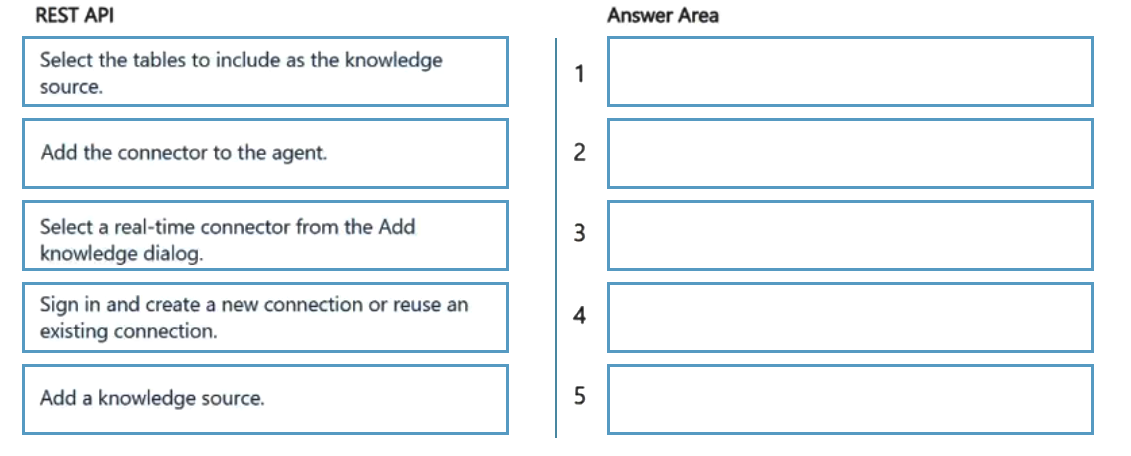
A company needs to ground an agent in Copilot Studio answers using live enterprise data from a supported system via a Microsoft Power Platform connector. To meet the business needs, the builder must meet the following requirements:
• Authenticate using a valid connection.
• Add the connector as a real-time knowledge source.
• Select the tables for knowledge grounding.
You need to add a Power Platform connector as a real-time knowledge source for the agent.
In which order should you perform the actions? To answer, move all actions from the list of actions to the answer area and arrange them in the correct order.
Show Answer
Correct Answer: 1. Add a knowledge source.
2. Select a real-time connector from the Add knowledge dialog.
3. Sign in and create a new connection or reuse an existing connection.
4. Select the tables to include as the knowledge source.
5. Add the connector to the agent.
Explanation: Choose the connector, authenticate, and specify the tables it can use before adding it to the agent.
Question 8
A company uses an agent in Copilot Studio that produces structured responses using a reusable instruction template. The responses follow the required tone and format. During a compliance review, the team discovers that the responses were generated using a model that is not on the approved list.
The company requires that the reusable instruction template continues to be used and the model used for prompt-driven responses meets governance requirements.
The solution must ensure that prompt-driven responses are generated using an approved model.
You need to configure the solution that meets the requirements.
Which two actions should you perform? Each correct answer presents part of the solution.
NOTE: Each correct selection is worth one point.
A. Select an approved model from the Microsoft Foundry model catalog in the configuration that is used for prompt-driven response generation.
B. Configure Azure AI Search as the grounding source so the approved model requirement is enforced during response generation.
C. Ensure the reusable instruction template is the one applied to the agent that generates the structured response.
D. Publish the agent so that the model used by prompt-driven responses is updated automatically.
E. Enable citations so generated responses can be traced and comply with governance requirements.
F. Add a line to the instruction template that requires the agent to use only approved models when generating responses.
Show Answer
Correct Answer: A, C
Explanation: Select an approved model in the configuration used for prompt-driven response generation, and ensure the reusable instruction template remains applied to the agent. Model selection is an administrative configuration setting; it cannot be enforced by adding instructions to the prompt. Grounding, citations, and publishing do not select an approved model.
Question 9
DRAG DROP
A company needs an agent to answer questions using live enterprise records and to execute a limited set of operations in the same system.
To meet the business needs, the agent must meet the following requirements:
The agent must update a record using authenticated access.
The agent must answer questions using live data at runtime.
The agent must avoid indexing enterprise data into a search index.
You need to select the correct Power Platform connector approach for each requirement.
Which option should you use for each requirement? To answer, move the appropriate solutions to the correct requirements. You may use each solution once, more than once, or not at all. You may need to move the split bar between panes or scroll to view content.
NOTE: Each correct selection is worth one point.
Show Answer
Correct Answer: Update a record using authenticated access: Power Platform connector tool
Answer questions using live data at runtime: Power Platform connector as real-time knowledge
Avoid indexing enterprise data into a search index: Power Platform connector as real-time knowledge
Explanation: A connector tool performs authenticated actions. Real-time knowledge retrieves data when the agent is asked, without indexing the enterprise content.
Question 10
HOTSPOT
You run multiple evaluation tests for an agent in Copilot Studio before expanding user access.
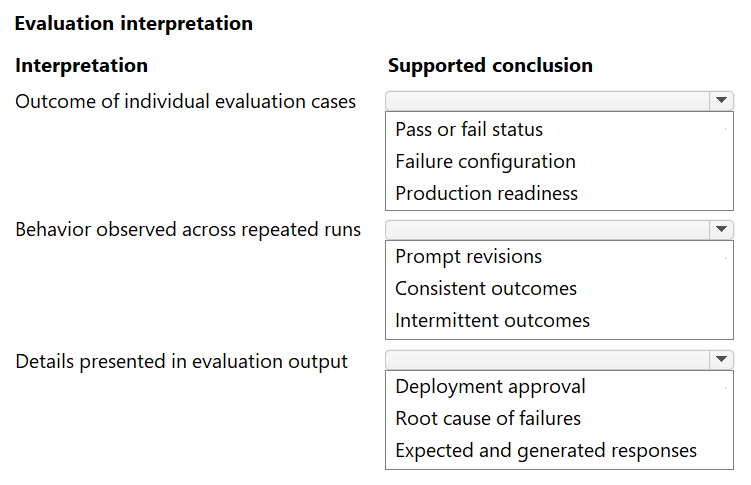
You observe the following about the evaluation results:
Each evaluation case is reported as meeting or missing the expected response.
Some evaluation cases fail repeatedly across several runs.
Each run displays the expected response and the response generated by the agent.
You need to interpret what the evaluation results reveal.
What should you conclude based on each interpretation? To answer, select the appropriate options in the answer area.
NOTE: Each correct selection is worth one point.
Show Answer
Correct Answer: Outcome of individual evaluation cases → Pass or fail status
Behavior observed across repeated runs → Consistent outcomes
Details presented in evaluation output → Expected and generated responses
Explanation: Each case is marked as meeting or missing the expected response. Repeated failures indicate a consistent outcome, and each run shows both the expected and generated responses.
$19
Get all 49 questions with detailed answers and explanations
Instant download HTML + PDF delivered the moment payment clears.
Secure Stripe checkout we never see or store your card details.
7-day refund if files are defective see our refund policy.