Professional Data Engineer Free Practice Questions — Page 4
Question 13
You are designing BigQuery tables for large volumes of clickstream event data. Your data analyst team will most frequently query by specific event date ranges and filter by the user ID UUID. You want to optimize table structure for query cost and performance. What should you do?
A. Partition the table by the user ID column and cluster the table by the event date column.
B. Create an ingestion-time partitioned table and cluster it by the user ID column.
C. Cluster the table by both the event date and the user ID columns.
D. Partition the table by the event date column and cluster the table by user ID column.
Show Answer
Correct Answer: D
Explanation: For clickstream data queried primarily by event date ranges, partitioning on the event date enables partition pruning, reducing scanned data and query cost. Clustering by user ID further optimizes queries that filter within those date partitions by UUID. Partitioning by high-cardinality user IDs is not appropriate, and ingestion-time partitioning is less optimal when queries use the actual event date.
Question 14
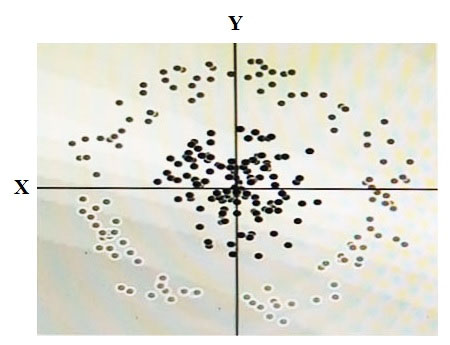
You have some data, which is shown in the graphic below. The two dimensions are X and Y, and the shade of each dot represents what class it is. You want to classify this data accurately using a linear algorithm. To do this you need to add a synthetic feature. What should the value of that feature be?
A. X2+Y2
B. X2
C. Y2
D. cos(X)
Show Answer
Correct Answer: A
Explanation: The classes are separated roughly by distance from the origin: one class is concentrated near the center and the other farther out. Adding the feature X² + Y² gives a linear classifier a measure of squared radial distance, allowing it to separate the classes with a threshold corresponding to a circular boundary in the original X–Y space.
Question 15
MJTelco Case Study -
Company Overview -
MJTelco is a startup that plans to build networks in rapidly growing, underserved markets around the world. The company has patents for innovative optical communications hardware. Based on these patents, they can create many reliable, high-speed backbone links with inexpensive hardware.
Company Background -
Founded by experienced telecom executives, MJTelco uses technologies originally developed to overcome communications challenges in space. Fundamental to their operation, they need to create a distributed data infrastructure that drives real-time analysis and incorporates machine learning to continuously optimize their topologies. Because their hardware is inexpensive, they plan to overdeploy the network allowing them to account for the impact of dynamic regional politics on location availability and cost.
Their management and operations teams are situated all around the globe creating many-to-many relationship between data consumers and provides in their system. After careful consideration, they decided public cloud is the perfect environment to support their needs.
Solution Concept -
MJTelco is running a successful proof-of-concept (PoC) project in its labs. They have two primary needs:
✑ Scale and harden their PoC to support significantly more data flows generated when they ramp to more than 50,000 installations.
✑ Refine their machine-learning cycles to verify and improve the dynamic models they use to control topology definition.
MJTelco will also use three separate operating environments `" development/test, staging, and production `" to meet the needs of running experiments, deploying new features, and serving production customers.
Business Requirements -
✑ Scale up their production environment with minimal cost, instantiating resources when and where needed in an unpredictable, distributed telecom user community.
✑ Ensure security of their proprietary data to protect their leading-edge machine learning and analysis.
✑ Provide reliable and timely access to data for analysis from distributed research workers
✑ Maintain isolated environments that support rapid iteration of their machine-learning models without affecting their customers.
Technical Requirements -
Ensure secure and efficient transport and storage of telemetry data
✑ Rapidly scale instances to support between 10,000 and 100,000 data providers with multiple flows each.
✑ Allow analysis and presentation against data tables tracking up to 2 years of data storing approximately 100m records/day
✑ Support rapid iteration of monitoring infrastructure focused on awareness of data pipeline problems both in telemetry flows and in production learning cycles.
CEO Statement -
Our business model relies on our patents, analytics and dynamic machine learning. Our inexpensive hardware is organized to be highly reliable, which gives us cost advantages. We need to quickly stabilize our large distributed data pipelines to meet our reliability and capacity commitments.
CTO Statement -
Our public cloud services must operate as advertised. We need resources that scale and keep our data secure. We also need environments in which our data scientists can carefully study and quickly adapt our models. Because we rely on automation to process our data, we also need our development and test environments to work as we iterate.
CFO Statement -
The project is too large for us to maintain the hardware and software required for the data and analysis. Also, we cannot afford to staff an operations team to monitor so many data feeds, so we will rely on automation and infrastructure. Google Cloud's machine learning will allow our quantitative researchers to work on our high-value problems instead of problems with our data pipelines.
MJTelco needs you to create a schema in Google Bigtable that will allow for the historical analysis of the last 2 years of records. Each record that comes in is sent every 15 minutes, and contains a unique identifier of the device and a data record. The most common query is for all the data for a given device for a given day.
Which schema should you use?
A. Rowkey: date#device_id Column data: data_point
B. Rowkey: date Column data: device_id, data_point
C. Rowkey: device_id Column data: date, data_point
D. Rowkey: data_point Column data: device_id, date
E. Rowkey: date#data_point Column data: device_id
Show Answer
Correct Answer: A
Explanation: A row keyed by date and device ID groups that device’s 15-minute readings for a day, matching the most common query without creating a single row for its entire two-year history. In practice, device_id#date would be preferable because putting the current date first can concentrate writes, but it is not an option.
Question 16
Your organization stores highly personal data in BigQuery and needs to comply with strict data privacy regulations. You need to ensure that sensitive data values are rendered unreadable whenever an employee leaves the organization. What should you do?
A. Use column-level access controls with policy tags and revoke viewer permissions when employees leave the organization.
B. Use dynamic data masking and revoke viewer permissions when employees leave the organization.
C. Use customer-managed encryption keys (CMEK) and delete keys when employees leave the organization.
D. Use AEAD functions and delete keys when employees leave the organization.
Show Answer
Correct Answer: D
Explanation: AEAD functions provide application-level encryption of individual data values in BigQuery. If the encryption keys are deleted or destroyed, the encrypted values become unreadable, satisfying the requirement that sensitive data values become unreadable. Column-level access controls and dynamic data masking only restrict or mask access but do not render the underlying stored values unreadable. Deleting a CMEK would make entire tables inaccessible and is not appropriate for selectively protecting sensitive values at the data level.
Question 17
Your company wants to implement a Retrieval-Augmented Generation (RAG) system to allow employees to query an extensive knowledge base of internal documents, such as policy manuals and project reports. You need to prepare this unstructured text for embedding to be used in the RAG system. What should you do to ensure the system can retrieve the most relevant information?
A. Use Cloud Data Loss Prevention (Cloud DLP) to scan and redact sensitive information within the documents before processing.
B. Store the documents as compressed files in a traditional relational database to enable more efficient storage and retrieval.
C. Convert the unstructured documents into high-dimensional numerical vectors that capture the semantic meaning and relationships of the text.
D. Index each word from the documents into a search engine to enable keyword-based search.
Show Answer
Correct Answer: C
Explanation: RAG systems retrieve relevant context using embeddings. To prepare unstructured text for embedding, the documents should be transformed into high-dimensional vector representations that capture semantic meaning, enabling similarity search in a vector index or database. Keyword indexing alone does not provide semantic retrieval, relational databases are not appropriate for embedding-based retrieval, and DLP addresses data protection rather than retrieval quality.
Question 18
You are designing a stateful data processing pipeline that reads data from a Cloud Storage bucket and writes transformed data to a BigQuery table. The pipeline must be highly available and resilient to zonal failures within the us-central1 region. You need to configure a Dataflow pipeline ensuring minimal disruption during a zonal outage. What should you do?
A. Launch the Dataflow job with the --region=us-central1 parameter.
B. Deploy the Dataflow job to a single zone within us-central1 and configure it to use a regional persistent disk to store its state.
C. Deploy the Dataflow job to a single zone within us-central1 and use a multi-regional Cloud Storage bucket to store its state.
D. Launch the Dataflow job with the --zone=us-central1a parameter.
Show Answer
Correct Answer: A
Explanation: Using the regional endpoint (--region=us-central1) allows Dataflow to manage workers across multiple zones in the region, improving resilience to zonal failures for stateful pipelines. Specifying a single zone reduces availability, and Dataflow state is managed by the service rather than by manually storing it in Cloud Storage or configuring regional persistent disks for this purpose.
Question 19
Your team has created several BigQuery curated datasets containing anonymized industry benchmark data. You want to make these datasets easily discoverable and accessible for querying by external partner companies within their own Google Cloud projects. You need a secure and scalable solution. What should you do?
A. Publish the datasets as listings within BigQuery sharing (Analytics Hub).
B. Export the datasets to partner-specific Cloud Storage buckets.
C. Create authorized views for each dataset and grant access to each partner.
D. Grant the roles/bigquery.dataViewer IAM role to the partner group email addresses on the datasets.
Show Answer
Correct Answer: A
Explanation: BigQuery sharing (Analytics Hub) is designed for secure, scalable sharing of BigQuery datasets across organizations. Publishing curated datasets as listings makes them discoverable and queryable by external partners in their own Google Cloud projects without copying data. Exporting to Cloud Storage creates data copies and operational overhead, authorized views do not scale well for many partners, and directly granting dataset IAM access lacks the discovery and exchange capabilities of Analytics Hub.
Question 20
You need to orchestrate a pipeline with several Google Cloud services: a batch Dataflow job, then a BigQuery query job followed by a Vertex AI batch prediction. The logic is sequential. You want a lightweight, serverless orchestration solution with minimal operational overhead. What service should you use?
A. Select Cloud Composer.
B. Select Compute Engine with cron.
C. Select Dataproc with Apache Oozie.
D. Select Cloud Workflows.
Show Answer
Correct Answer: D
Explanation: Cloud Workflows is the best fit for lightweight, serverless orchestration of sequential Google Cloud service calls such as launching a Dataflow batch job, waiting for completion, running a BigQuery job, and then invoking a Vertex AI batch prediction. It is designed for workflow orchestration with minimal operational overhead. Cloud Composer (Airflow) is more powerful but heavier to operate, while Compute Engine with cron and Dataproc/Oozie require unnecessary infrastructure or are not appropriate for this use case.
Question 21
Your company uses Looker Studio connected to BigQuery for reporting. Users are experiencing slow dashboard load times due to complex queries on a large table. The queries involve aggregations and filtering on several columns. You need to optimize query performance to decrease the dashboard load times. What should you do?
A. Configure Looker Studio to use a shorter data refresh interval to ensure fresh data is always displayed.
B. Create a materialized view in BigQuery that pre-calculates the aggregations and filters used in the Looker Studio dashboards.
C. Implement row-level security in BigQuery to restrict data access and reduce the amount of data processed by the queries.
D. Use BigQuery BI Engine to accelerate query performance by caching frequently accessed data.
Show Answer
Correct Answer: D
Explanation: BigQuery BI Engine is specifically designed to accelerate interactive analytics for BI tools such as Looker Studio by using an in-memory cache and optimized execution, reducing dashboard latency without changing report logic. Materialized views can help if queries exactly match the precomputed aggregations, but for Looker Studio dashboards the recommended acceleration feature is BI Engine.
Question 22
Your data science team needs to perform interactive SQL queries on large datasets stored in Apache Parquet format within a Cloud Storage bucket. The team is familiar with Apache Hive and wants to leverage existing HiveQL queries. You need to provide an environment for the team to run their interactive HiveQL queries directly against the data in Cloud Storage. You want to keep operational overhead to a minimum. What should you do?
A. Install and configure an Apache Hadoop and Hive cluster manually on a group of Compute Engine instances.
B. Load the Parquet data into a BigQuery native table and use the BigQuery Connector for Hive to run the queries.
C. Configure BigQuery with an external table definition pointing to the Parquet files.
D. Deploy a Dataproc cluster with Hive services enabled.
Show Answer
Correct Answer: D
Explanation: The requirement is to run interactive HiveQL queries directly against Parquet data stored in Cloud Storage while minimizing operational overhead. Dataproc is a managed Hadoop/Spark service that supports Hive out of the box, and Hive can query Parquet data stored in Cloud Storage. Manually managing Compute Engine clusters has higher overhead. BigQuery external tables support SQL, not interactive HiveQL execution, and loading data into BigQuery does not satisfy the requirement to leverage existing HiveQL directly.
$19
Get all 332 questions with detailed answers and explanations
Instant download HTML + PDF delivered the moment payment clears.
Secure Stripe checkout we never see or store your card details.
7-day refund if files are defective see our refund policy.