Professional Data Engineer Free Practice Questions — Page 3
Question 8
You are building a system to process financial transactions. The system must handle a high throughput of concurrent user operations and each operation requires low-latency reads and writes to individual records. You need to identify a storage solution that guarantees ACID compliance for the processed transactions. You want a Google Cloud managed service. What should you do?
A. Select Bigtable.
B. Select BigQuery.
C. Select Cloud Storage.
D. Select Spanner.
Show Answer
Correct Answer: D
Explanation: Cloud Spanner is Google Cloud's fully managed relational database designed for high-throughput, low-latency transactional workloads with strong consistency and full ACID transactions. Bigtable is a NoSQL database and does not provide full relational ACID transactions across rows. BigQuery is an analytical data warehouse, not an OLTP database. Cloud Storage is object storage and is not suitable for transactional record processing.
Question 9
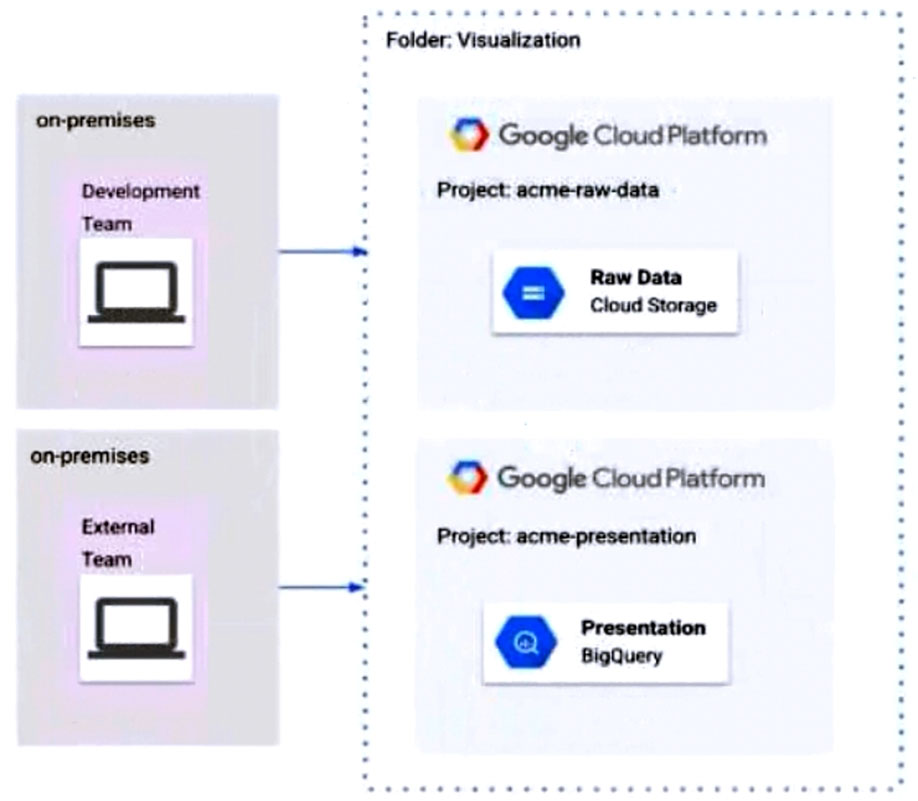
The Development and External teams have the project viewer Identity and Access Management (IAM) role in a folder named Visualization. You want the
Development Team to be able to read data from both Cloud Storage and BigQuery, but the External Team should only be able to read data from BigQuery. What should you do?
A. Remove Cloud Storage IAM permissions to the External Team on the acme-raw-data project.
B. Create Virtual Private Cloud (VPC) firewall rules on the acme-raw-data project that deny all ingress traffic from the External Team CIDR range.
C. Create a VPC Service Controls perimeter containing both projects and BigQuery as a restricted API. Add the External Team users to the perimeter's Access Level.
D. Create a VPC Service Controls perimeter containing both projects and Cloud Storage as a restricted API. Add the Development Team users to the perimeter's Access Level.
Show Answer
Correct Answer: D
Explanation: Place both projects in a VPC Service Controls perimeter and make Cloud Storage the restricted API. The External Team remains outside the perimeter and can still access BigQuery, which is not restricted. Add the Development Team to an access level so it can access the protected Cloud Storage service. Firewall rules do not control access to Google APIs, and option C restricts the wrong service.
Question 9
Your organization has thousands of images stored in Cloud Storage. The organization's data analysts need to categorize these images upon analyzing the image content and store the results in a structured format for integration with other BigQuery datasets. You need a solution that allows the analysts to perform this task with the least amount of coding. What should you do?
A. Use the Gemini 2.5 Pro model in Vertex AI to analyze the images and store the results in BigQuery.
B. Use the ML.UNDERSTAND_TEXT function along with object tables to analyze the images, and store the JSON output in a Cloud Storage bucket.
C. Use Vertex AI Vision API to analyze the images and store the results in BigQuery.
D. Use the ML.GENERATE_TEXT function along with object tables to analyze the images and store the JSON output in a BigQuery table.
Show Answer
Correct Answer: D
Explanation: ML.GENERATE_TEXT in BigQuery can use object tables that reference images in Cloud Storage and invoke Gemini models to analyze image content directly from SQL. The generated JSON can be written into a BigQuery table, making it easy to integrate with other BigQuery datasets while requiring minimal custom code. ML.UNDERSTAND_TEXT is for text understanding rather than image analysis, and using Vision API or Vertex AI directly would generally require more application code.
Question 10
Your company is performing data preprocessing for a learning algorithm in Google Cloud Dataflow. Numerous data logs are being are being generated during this step, and the team wants to analyze them. Due to the dynamic nature of the campaign, the data is growing exponentially every hour.
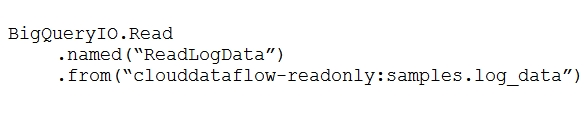
The data scientists have written the following code to read the data for a new key features in the logs.
You want to improve the performance of this data read. What should you do?
A. Specify the TableReference object in the code.
B. Use .fromQuery operation to read specific fields from the table.
C. Use of both the Google BigQuery TableSchema and TableFieldSchema classes.
D. Call a transform that returns TableRow objects, where each element in the PCollection represents a single row in the table.
Show Answer
Correct Answer: B
Explanation: Use `.fromQuery` with a query that selects only the required feature columns. This avoids reading and processing unnecessary columns as the log table grows. Specifying a table reference or returning `TableRow` objects does not by itself limit the columns read.
Question 10
You are developing a fraud detection model using BigQuery ML. You have a raw transaction dataset and need to create new features such as the average_transaction_amount_last_24_hours and time_since_last_transaction. These features require aggregation and time-window calculations on the existing data. The goal is to ensure that these features are consistently applied during both model training and prediction without manual intervention. You need to prepare these features efficiently for your model. What should you do?
A. Implement a Cloud Run function that triggers on new transactions, calculates the features, and inserts them into a feature store before model serving.
B. Export the BigQuery data to Cloud Storage, perform feature engineering using a custom Python script in a Dataflow job, and then re-import the engineered features into BigQuery.
C. Use the TRANSFORM clause within the CREATE MODEL statement, leveraging SQL functions for aggregations and time-based calculations.
D. Create a separate BigQuery table containing pre-computed features using complex SQL queries and join this table with the raw data during model training and serving.
Show Answer
Correct Answer: C
Explanation: The BigQuery ML TRANSFORM clause lets you define feature engineering as part of the CREATE MODEL statement. These SQL-based transformations, including aggregations and time-related calculations where supported by SQL expressions over the training query, are stored with the model and automatically applied during prediction, ensuring consistency between training and inference without maintaining separate preprocessing pipelines.
Question 11
You are using Google BigQuery as your data warehouse. Your users report that the following simple query is running very slowly, no matter when they run the query:
SELECT country, state, city FROM [myproject:mydataset.mytable] GROUP BY country
You check the query plan for the query and see the following output in the Read section of Stage:1:
What is the most likely cause of the delay for this query?
A. Users are running too many concurrent queries in the system
B. The [myproject:mydataset.mytable] table has too many partitions
C. Either the state or the city columns in the [myproject:mydataset.mytable] table have too many NULL values
D. Most rows in the [myproject:mydataset.mytable] table have the same value in the country column, causing data skew
Show Answer
Correct Answer: D
Explanation: Assuming the query is intended to run, the likely cause is data skew: if most rows share one country value, the GROUP BY can create an uneven workload and slow processing. Note that as written, the query is invalid in BigQuery because state and city are neither grouped nor aggregated.
Question 11
You analyze user clickstream data to personalize content recommendations. The data arrives continuously and needs to be processed with low latency, including transformations such as sessionization (grouping clicks by user within a time window) and aggregation of user activity. You need to identify a scalable solution to handle millions of events each second and be resilient to late-arriving data. What should you do?
A. Use Firebase Realtime Database for ingestion and storage, and Cloud Run functions for processing and analytics.
B. Use Cloud Data Fusion for ingestion and transformation, and Cloud SQL for storage and analytics.
C. Use Pub/Sub for ingestion, Dataflow with Apache Beam for processing, and BigQuery for storage and analytics.
D. Use Cloud Storage for ingestion, Dataproc with Apache Spark for batch processing, and BigQuery for storage and analytics.
Show Answer
Correct Answer: C
Explanation: Pub/Sub provides scalable event ingestion, Dataflow with Apache Beam supports low-latency stream processing, sessionization, windowing, aggregations, and robust handling of late-arriving data via event-time processing and watermarks. BigQuery is the appropriate analytics sink for large-scale querying of processed clickstream data.
Question 12
MJTelco Case Study -
Company Overview -
MJTelco is a startup that plans to build networks in rapidly growing, underserved markets around the world. The company has patents for innovative optical communications hardware. Based on these patents, they can create many reliable, high-speed backbone links with inexpensive hardware.
Company Background -
Founded by experienced telecom executives, MJTelco uses technologies originally developed to overcome communications challenges in space. Fundamental to their operation, they need to create a distributed data infrastructure that drives real-time analysis and incorporates machine learning to continuously optimize their topologies. Because their hardware is inexpensive, they plan to overdeploy the network allowing them to account for the impact of dynamic regional politics on location availability and cost.
Their management and operations teams are situated all around the globe creating many-to-many relationship between data consumers and provides in their system. After careful consideration, they decided public cloud is the perfect environment to support their needs.
Solution Concept -
MJTelco is running a successful proof-of-concept (PoC) project in its labs. They have two primary needs:
✑ Scale and harden their PoC to support significantly more data flows generated when they ramp to more than 50,000 installations.
✑ Refine their machine-learning cycles to verify and improve the dynamic models they use to control topology definition.
MJTelco will also use three separate operating environments `" development/test, staging, and production `" to meet the needs of running experiments, deploying new features, and serving production customers.
Business Requirements -
✑ Scale up their production environment with minimal cost, instantiating resources when and where needed in an unpredictable, distributed telecom user community.
✑ Ensure security of their proprietary data to protect their leading-edge machine learning and analysis.
✑ Provide reliable and timely access to data for analysis from distributed research workers
Maintain isolated environments that support rapid iteration of their machine-learning models without affecting their customers.
Technical Requirements -
✑ Ensure secure and efficient transport and storage of telemetry data
✑ Rapidly scale instances to support between 10,000 and 100,000 data providers with multiple flows each.
✑ Allow analysis and presentation against data tables tracking up to 2 years of data storing approximately 100m records/day
✑ Support rapid iteration of monitoring infrastructure focused on awareness of data pipeline problems both in telemetry flows and in production learning cycles.
CEO Statement -
Our business model relies on our patents, analytics and dynamic machine learning. Our inexpensive hardware is organized to be highly reliable, which gives us cost advantages. We need to quickly stabilize our large distributed data pipelines to meet our reliability and capacity commitments.
CTO Statement -
Our public cloud services must operate as advertised. We need resources that scale and keep our data secure. We also need environments in which our data scientists can carefully study and quickly adapt our models. Because we rely on automation to process our data, we also need our development and test environments to work as we iterate.
CFO Statement -
The project is too large for us to maintain the hardware and software required for the data and analysis. Also, we cannot afford to staff an operations team to monitor so many data feeds, so we will rely on automation and infrastructure. Google Cloud's machine learning will allow our quantitative researchers to work on our high-value problems instead of problems with our data pipelines.
You need to compose visualizations for operations teams with the following requirements:
✑ The report must include telemetry data from all 50,000 installations for the most resent 6 weeks (sampling once every minute).
✑ The report must not be more than 3 hours delayed from live data.
✑ The actionable report should only show suboptimal links.
✑ Most suboptimal links should be sorted to the top.
✑ Suboptimal links can be grouped and filtered by regional geography.
✑ User response time to load the report must be <5 seconds.
Which approach meets the requirements?
A. Load the data into Google Sheets, use formulas to calculate a metric, and use filters/sorting to show only suboptimal links in a table.
B. Load the data into Google BigQuery tables, write Google Apps Script that queries the data, calculates the metric, and shows only suboptimal rows in a table in Google Sheets.
C. Load the data into Google Cloud Datastore tables, write a Google App Engine Application that queries all rows, applies a function to derive the metric, and then renders results in a table using the Google charts and visualization API.
D. Load the data into Google BigQuery tables, write a Google Data Studio 360 report that connects to your data, calculates a metric, and then uses a filter expression to show only suboptimal rows in a table.
Show Answer
Correct Answer: D
Explanation: BigQuery is suited to storing and querying the very large telemetry dataset, while Data Studio can connect to it to calculate metrics and create a filtered, sortable report grouped by region. This avoids loading the data into Sheets or building a custom application; the BigQuery queries and report can be designed to meet the freshness and response-time targets.
Question 12
Your Cloud Storage data lake has raw, processed, and historical data in different buckets. Data older than two years is rarely accessed, and all data must be retained for no longer than seven years. You are concerned about rising storage costs. How should you control costs for the historical data bucket?
A. Write a script on a Compute Engine instance, triggered daily by Cloud Scheduler, to scan all objects and delete any older than seven years.
B. Configure an Object Lifecycle Management rule to transition objects older than two years to the Archive storage class and eventually delete them after seven years.
C. Enable the Autoclass feature on your Cloud Storage buckets and select Opt-in to object transitions to Coldline and Archive storage classes.
D. Replicate the buckets to a different region with lower storage costs and configure an Object Lifecycle Management rule to delete objects after seven years.
Show Answer
Correct Answer: B
Explanation: Object Lifecycle Management is designed to automate storage class transitions and object deletion based on object age. Moving objects older than two years to Archive minimizes storage costs for infrequently accessed data, and configuring deletion at seven years satisfies the retention limit without custom scripts. Autoclass does not provide a fixed-age retention/deletion policy, and replicating to another region is not a cost-optimization strategy for this requirement.
Question 13
Flowlogistic Case Study -
Company Overview -
Flowlogistic is a leading logistics and supply chain provider. They help businesses throughout the world manage their resources and transport them to their final destination. The company has grown rapidly, expanding their offerings to include rail, truck, aircraft, and oceanic shipping.
Company Background -
The company started as a regional trucking company, and then expanded into other logistics market. Because they have not updated their infrastructure, managing and tracking orders and shipments has become a bottleneck. To improve operations, Flowlogistic developed proprietary technology for tracking shipments in real time at the parcel level. However, they are unable to deploy it because their technology stack, based on Apache Kafka, cannot support the processing volume. In addition, Flowlogistic wants to further analyze their orders and shipments to determine how best to deploy their resources.
Solution Concept -
Flowlogistic wants to implement two concepts using the cloud:
Use their proprietary technology in a real-time inventory-tracking system that indicates the location of their loads
✑ Perform analytics on all their orders and shipment logs, which contain both structured and unstructured data, to determine how best to deploy resources, which markets to expand info. They also want to use predictive analytics to learn earlier when a shipment will be delayed.
Existing Technical Environment -
Flowlogistic architecture resides in a single data center:
✑ Databases
8 physical servers in 2 clusters
- SQL Server `" user data, inventory, static data
3 physical servers
- Cassandra `" metadata, tracking messages
10 Kafka servers `" tracking message aggregation and batch insert
✑ Application servers `" customer front end, middleware for order/customs
60 virtual machines across 20 physical servers
- Tomcat `" Java services
- Nginx `" static content
- Batch servers
✑ Storage appliances
- iSCSI for virtual machine (VM) hosts
- Fibre Channel storage area network (FC SAN) `" SQL server storage
- Network-attached storage (NAS) image storage, logs, backups
✑ 10 Apache Hadoop /Spark servers
- Core Data Lake
- Data analysis workloads
✑ 20 miscellaneous servers
- Jenkins, monitoring, bastion hosts,
Business Requirements -
✑ Build a reliable and reproducible environment with scaled panty of production.
✑ Aggregate data in a centralized Data Lake for analysis
✑ Use historical data to perform predictive analytics on future shipments
✑ Accurately track every shipment worldwide using proprietary technology
✑ Improve business agility and speed of innovation through rapid provisioning of new resources
✑ Analyze and optimize architecture for performance in the cloud
✑ Migrate fully to the cloud if all other requirements are met
Technical Requirements -
Handle both streaming and batch data
✑ Migrate existing Hadoop workloads
✑ Ensure architecture is scalable and elastic to meet the changing demands of the company.
✑ Use managed services whenever possible
✑ Encrypt data flight and at rest
✑ Connect a VPN between the production data center and cloud environment
SEO Statement -
We have grown so quickly that our inability to upgrade our infrastructure is really hampering further growth and efficiency. We are efficient at moving shipments around the world, but we are inefficient at moving data around.
We need to organize our information so we can more easily understand where our customers are and what they are shipping.
CTO Statement -
IT has never been a priority for us, so as our data has grown, we have not invested enough in our technology. I have a good staff to manage IT, but they are so busy managing our infrastructure that I cannot get them to do the things that really matter, such as organizing our data, building the analytics, and figuring out how to implement the CFO' s tracking technology.
CFO Statement -
Part of our competitive advantage is that we penalize ourselves for late shipments and deliveries. Knowing where out shipments are at all times has a direct correlation to our bottom line and profitability. Additionally, I don't want to commit capital to building out a server environment.
Flowlogistic's CEO wants to gain rapid insight into their customer base so his sales team can be better informed in the field. This team is not very technical, so they've purchased a visualization tool to simplify the creation of BigQuery reports. However, they've been overwhelmed by all the data in the table, and are spending a lot of money on queries trying to find the data they need. You want to solve their problem in the most cost-effective way. What should you do?
A. Export the data into a Google Sheet for virtualization.
B. Create an additional table with only the necessary columns.
C. Create a view on the table to present to the virtualization tool.
D. Create identity and access management (IAM) roles on the appropriate columns, so only they appear in a query.
Show Answer
Correct Answer: C
Explanation: Create a BigQuery view that exposes only the columns the sales team needs. A logical view avoids storing a duplicate table, keeps data current, and lets queries against the view scan only the referenced columns, reducing query costs and simplifying the data presented to the visualization tool.
$19
Get all 332 questions with detailed answers and explanations
Instant download HTML + PDF delivered the moment payment clears.
Secure Stripe checkout we never see or store your card details.
7-day refund if files are defective see our refund policy.