Professional Cloud Architect Free Practice Questions
This is the free Google Professional Cloud Architect practice question bank —
160 of 307 total questions, each with a full explanation, free to
read with no signup required. Updated 2026-10-13.
Every answer is verified against official Google documentation —
see our methodology.
Question 1
A financial services company is decommissioning one of its on-premises data centers. As part of this initiative, the company needs to perform a one-time migration of 500 ТВ of historical transaction archives to a Cloud Storage bucket for long-term retention. The data center’s internet egress is 1 Gbps, which is shared with critical business operations. You must complete the secure data transfer within a 60-day window to meet the decommissioning deadline. What should you do?
A. Provision a Partner Interconnect connection with a 10 Gbps capacity to accelerate the data transfer, and then use Storage Transfer Service.
B. Write a script that uses the gcloud storage cp --parallel command to upload the data in chunks over the public internet during off-peak hours.
C. Use Storage Transfer Service to create an agent-based transfer job that moves the data from the on-premises file servers directly to the Cloud Storage bucket.
D. Order a Transfer Appliance, copy the data to the appliance using your high-speed local network, and ship it back to Google to upload the data into your Cloud Storage bucket.
Show Answer
Correct Answer: D
Explanation: 500 TB over a shared 1 Gbps internet connection is impractical within the constraints and would consume bandwidth needed for business operations. A Transfer Appliance is designed for large one-time bulk migrations: copy data locally at high speed, ship the appliance to Google, and Google uploads the data securely into Cloud Storage. Partner Interconnect would require provisioning new connectivity and Storage Transfer Service alone still depends on available network bandwidth.
Question 1
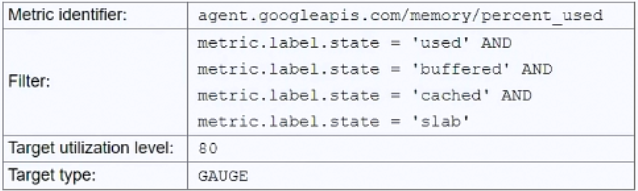
You have a Compute Engine application that you want to autoscale when total memory usage exceeds 80%. You have installed the Cloud Monitoring agent and configured the autoscaling policy as follows:
You observe that the application does not scale under high load. You want to resolve this. What should you do?
A. Change the Target type to DELTA_PER_MINUTE.
B. Change the Metric identifier to agent.googleapis.com/memory/bytes_used.
C. Change the filter to metric.label.state = ‘used’.
D. Change the filter to metric.label.state = ‘free’ and the Target utilization to 20.
Show Answer
Correct Answer: C
Explanation: The metric is already set to `agent.googleapis.com/memory/percent_used`, and a target of 80 with a GAUGE target type is appropriate. The filter requires one time series to have four different values for the same `state` label simultaneously, so it matches no series. Change the filter to `metric.label.state = 'used'`.
Question 1
Company Overview -
KnightMotives is a car manufacturer specializing in autonomous, self-driving vehicles, including Battery Electric Vehicles (BEVs), hybrids and traditional internal combustion engine (ICE) vehicles. While KnightMotives has made strides with the in-vehicle experience in their BEV fleet, the hybrid and ICE vehicles have yet to implement these new systems and are viewed poorly by critics and drivers. The lack of modern in-vehicle technology in hybrid and ICE vehicles has resulted in declining sales and customer satisfaction.
KnightMotives wants to modernize the consumer experience across all vehicles within five years Artificial Intelligence offers a unique opportunity to revolutionize the in-vehicle experience, as well as the shopping buying and service/maintenance experience. Investment in this new technology will require a shift in financial priorities on a global scale.
KnightMotives also wants to improve their online ordering system, which is unreliable. Systems for customers to build their vehicle online for acquisition through a dealer are not delivering the data or reliability that dealers need, causing. A strain in the relationship between KnightMotives and dealers. Service technicians and sales staff need better tooling to enhance dealer successes, including built-to-order vehicles.
Solution Concept -
KnightMotives wants to shift from manufacturing cars to creating a complete and compelling “automotive experience.” Then strategy prioritizes delivering a consistent experience across all models, developing AI-powered features, generating new revenue from data monetization, adopting a digital focus to differentiate their brand from competitors, and developing better tools for mechanics and salespeople.
Existing Technical Environment -
KnightMotives's IT is largely on-premises with some applications on major cloud platforms. Their supply chain runs on an outdated mainframe, and Enterprise Resource Planning (ERP) is also outdated, making new promotions and dealer discounts difficult to implement. Dealers have no budget for new equipment. There is fragmentation across vehicles with multiple code bases, and significant technical debt from supporting backwards compatibility. Network connectivity to manufacturing plants and vehicle connectivity in rural areas are challenges.
Business Requirements -
Key business requirements include fostering a personalized relationship with the driver and delivering a cohesive experience across all models. Creating a better build-to-order model will reduce time on the lot and provide transparency for both dealers and customers. Additionally, KnightMotives seeks to monetize corporate data to finance new technology investments, as their current AI infrastructure is obsolete and corporate data remains siloed. Security is a paramount concern due to past data breaches Adherence to European Union (EU) data protection regulations, especially for emerging autonomous platforms, is critical.
KnightMotives plans to make significant investments in fully autonomous driving capabilities, with initial implementation targeting regions with favorable regulatory environments. Prioritizing employee upskilling, attracting top-tier talent, and fostering better communication between business and technical teams are also critical objectives.
Technical Requirements -
• Modernizing the in-vehicle experience includes developing a consistent user experience (UX) that seamlessly integrates AI-powered features across all models, updating in-vehicle hardware and software in legacy models to support new UX features and AI capabilities, and ensuring reliable network connectivity, especially in rural areas, to support real-time AI features and data transmission.
• Network upgrades are necessary to support increased data traffic and improve connectivity between plants and headquarters.
• IT infrastructure modernization requires adopting a hybrid cloud strategy to leverage the benefits of both on-premises and cloud infrastructure, and gradually modernizing or replacing legacy systems to improve efficiency and agility.
• Autonomous vehicle development and testing requires investing in cutting-edge AI and machine learning technologies, building a robust simulation environment, and ensuring compliance with evolving regulations related to autonomous vehicles.
• Data monetization and insights requires implementing a robust data management platform, strict data security and privacy measures, and a scalable AI/ML infrastructure.
• Increased focus on security and risk management involves implementing a comprehensive security framework to protect against cyber threats and data breaches, developing an incident response plan, and providing security awareness training to employees.
• Providing a delightful experience for dealers and customers requires improving the online build-to-order system; developing modern dealer tools to streamline dealer operations, including sales, service, and inventory management; and implementing a comprehensive Customer Relationship Management (CRM) system to track customer interactions personalize experiences, and improve customer satisfaction.
Executive Statement -
KnightMotives is committed to enhancing safety and saving lives by leveraging an extensive body of data — encompassing driving, road conditions, behavioral studies, and crash safety statistics — to create compelling digital experiences for drivers. Our AI consistently outperforms national safety statistics, ensuring the unique and coveted KnightMotives experience is aligned across all our vehicle models.
Michael Knight, KnightMotives CEO
For this question, refer to the KnightMotives Automotive case study, KnightMotives has deployed their new Dealer Tools on Google Kubernetes Engine (GKE). You are supporting KnightMotives in the performance of the GKE workloads. Some of the Pods are Statefull. To ensure these Pods do not consume an unlimited amount of CPU, you have configured resource limits on the Deployments. You have identified that these Pods were allocated too much CPU and are actually consuming drastically less some of the time. You want to optimize resource usage and allow maximum flexibility in case of higher load. What should you do?
A. Configure resource requests per Deployment. Set resource requests slightly above the typical CPU usage observed during monitoring.
B. Configure resource requests per Deployment. Ensure the requests are equal to the current limits.
C. Enable vertical Pod autoscaling on each Deployment. Ensure the autoscaling mode is set to Auto.
D. Enable horizontal Pod autoscaling on each Deployment. Ensure the minimum number of Pods is lower than the currently configured amount in the Deployment.
Show Answer
Correct Answer: A
Explanation: When a CPU limit is set without a separate request, Kubernetes uses the limit as the request, reserving more CPU than these Pods typically need. Set requests slightly above observed typical usage while retaining the higher limits. This improves scheduling efficiency and still lets the Pods use extra CPU when load rises.
Question 1
A large enterprise is building a file processing pipeline on Google Cloud. The pipeline ingests the raw files, which are then accessed by a fleet of hundreds of Compute Engine virtual machines (VMs) in a single region for parallel processing. These VMs need concurrent, low-latency read and write access to a shared file system. You need to implement a storage solution that delivers the highest possible throughput to minimize the overall processing time. What should you do?
A. Use a multi-region Cloud Storage bucket to store the files.
B. Create a Filestore Enterprise instance in the same region as the VMs. Mount the Filestore file share on each Compute Engine VM.
C. Create a Filestore Zonal instance in each zone where the VMs are running. Mount the Filestore file share on each Compute Engine VM.
D. Create a Regional Persistent Disk and attach it to all VMs in multi-writer mode.
Show Answer
Correct Answer: C
Explanation: Filestore Zonal provides a low-latency NFS file share for concurrent VM access and is the higher-throughput Filestore choice for this workload. Place instances near the VMs that use them. Each zonal instance is a separate share, however; if every VM must access the *same* files across zones, they must mount the same instance rather than separate zone-local shares.
Sources:
https://cloud.google.com/architecture/filers-on-compute-engine
Question 2
Your company wants to migrate their 10-TB on-premises database export into Cloud Storage. You want to minimize the time it takes to complete this activity, the overall cost, and database load. The bandwidth between the on-premises environment and Google Cloud is 1 Gbps. You want to follow Google-recommended practices. What should you do?
A. Develop a Dataflow job to read data directly from the database and write it into Cloud Storage.
B. Use the Data Transfer appliance to perform an offline migration.
C. Use a commercial partner ETL solution to extract the data from the on-premises database and upload it into Cloud Storage.
D. Compress the data and upload it with gsutil -m to enable multi-threaded copy.
Show Answer
Correct Answer: D
Explanation: The database export already exists, so uploading it avoids the additional database load of extracting it again. Compressing the export reduces the data sent over the 1-Gbps link, and `gsutil -m` parallelizes the upload. At that bandwidth, transferring 10 TB takes roughly a day under ideal conditions; shipping a Transfer Appliance would generally take much longer.
Sources:
https://cloud.google.com/blog/products/databases/how-broadcom-migrated-to-google-cloud-sql
https://cloud.google.com/blog/products/storage-data-transfer/best-practices-for-large-scale-migrations-to-google-cloud
Question 2
Auditors visit your teams every 12 months and ask to review all the Google Cloud Identity and Access Management (Cloud IAM) policy changes in the previous 12 months. You want to streamline and expedite the analysis and audit process.
What should you do?
A. Create custom Google Stackdriver alerts and send them to the auditor
B. Enable Logging export to Google BigQuery and use ACLs and views to scope the data shared with the auditor
C. Use cloud functions to transfer log entries to Google Cloud SQL and use ACLs and views to limit an auditor's view
D. Enable Google Cloud Storage (GCS) log export to audit logs into a GCS bucket and delegate access to the bucket
Show Answer
Correct Answer: B
Explanation: Export the audit logs to BigQuery so the auditor can efficiently query IAM policy changes across the full 12-month period. Use access controls and views to limit the data they can see. Cloud Storage is useful for low-cost archival, but it is less convenient for analysis.
Question 2
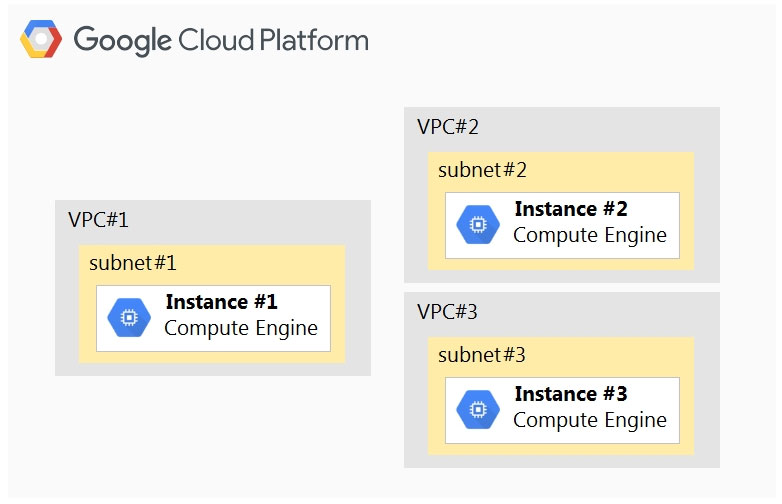
Your company has a project in Google Cloud with three Virtual Private Clouds (VPCs). There is a Compute Engine instance on each VPC. Network subnets do not overlap and must remain separated. The network configuration is shown below.
Instance #1 is an exception and must communicate directly with both Instance #2 and Instance #3 via internal IPs. How should you accomplish this?
A. Create a cloud router to advertise subnet #2 and subnet #3 to subnet #1.
B. Add two additional NICs to Instance #1 with the following configuration: ג€¢ NIC1 ג—‹ VPC: VPC #2 ג—‹ SUBNETWORK: subnet #2 ג€¢ NIC2 ג—‹ VPC: VPC #3 ג—‹ SUBNETWORK: subnet #3 Update firewall rules to enable traffic between instances.
C. Create two VPN tunnels via CloudVPN: ג€¢ 1 between VPC #1 and VPC #2. ג€¢ 1 between VPC #2 and VPC #3. Update firewall rules to enable traffic between the instances.
D. Peer all three VPCs: ג€¢ Peer VPC #1 with VPC #2. ג€¢ Peer VPC #2 with VPC #3. Update firewall rules to enable traffic between the instances.
Show Answer
Correct Answer: B
Explanation: Configure Instance #1 with an interface in each VPC, allowing it to communicate with Instances #2 and #3 over their internal IPs without connecting the VPCs to each other. Apply firewall rules that permit the required traffic. Note: Compute Engine NICs cannot be added to an existing VM, so Instance #1 must be created or recreated with the additional interfaces. VPC peering is not transitive, so peering VPC #1 to #2 and #2 to #3 would not provide the required path from #1 to #3.
Question 2
Your company is a global financial services provider that processes and analyzes a high volume of credit card transactions in real time for fraud detection. Your analytics team must run complex batch queries on the same transaction data for daily reporting. You need to design a data processing solution that can handle both real-time and batch processing of the transaction data while minimizing operational overhead and infrastructure management. What should you do?
A. Use Dataprep to ingest the transactions.
B. Use Dataflow to process the streaming data.
C. Use a Dataproc cluster for both the streaming and batch workloads.
D. Use BigQuery for the batch analytics reports.
E. Use Firestore to store and analyze the transaction data.
Show Answer
Correct Answer: B, D
Explanation: Use Dataflow for serverless, scalable real-time stream processing of high-volume transaction data, which also supports unified batch/stream processing with Apache Beam while minimizing operational overhead. Use BigQuery as the serverless data warehouse for complex batch analytics and daily reporting. Dataproc requires cluster management, Dataprep is for data preparation rather than streaming pipelines, and Firestore is not designed for large-scale analytical queries.
Question 3
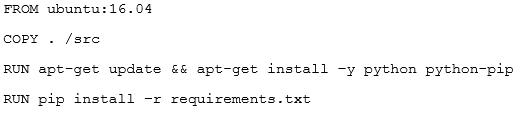
One of the developers on your team deployed their application in Google Container Engine with the Dockerfile below. They report that their application deployments are taking too long.
You want to optimize this Dockerfile for faster deployment times without adversely affecting the app's functionality.
Which two actions should you take? (Choose two.)
A. Remove Python after running pip
B. Remove dependencies from requirements.txt
C. Use a slimmed-down base image like Alpine Linux
D. Use larger machine types for your Google Container Engine node pools
E. Copy the source after he package dependencies (Python and pip) are installed
Show Answer
Correct Answer: C, E
Explanation: Use a smaller base image to reduce the image size that must be transferred to nodes. Also, install dependencies before copying frequently changing application source, so source-code changes can reuse cached dependency layers. In practice, copy `requirements.txt` first, install from it, and then copy the source. Removing Python or required dependencies could break the application, and larger node types do not optimize the image itself.
Question 3
Your company wants you to build a highly reliable web application with a few public APIs as the backend. You don't expect a lot of user traffic, but traffic could spike occasionally. You want to leverage Cloud Load Balancing, and the solution must be cost-effective for users. What should you do?
A. Store static content such as HTML and images in Cloud CDN. Host the APIs on App Engine and store the user data in Cloud SQL.
B. Store static content such as HTML and images in a Cloud Storage bucket. Host the APIs on a zonal Google Kubernetes Engine cluster with worker nodes in multiple zones, and save the user data in Cloud Spanner.
C. Store static content such as HTML and images in Cloud CDN. Use Cloud Run to host the APIs and save the user data in Cloud SQL.
D. Store static content such as HTML and images in a Cloud Storage bucket. Use Cloud Functions to host the APIs and save the user data in Firestore.
Show Answer
Correct Answer: D
Explanation: Use Cloud Storage for static files, Cloud Functions for the small set of APIs, and Firestore for user data. These managed, serverless services can scale for occasional spikes while avoiding the always-on infrastructure and higher baseline costs of options such as GKE or Cloud SQL. Cloud Load Balancing can route requests to serverless backends and a Cloud Storage backend bucket.
$19
Get all 307 questions with detailed answers and explanations
Instant download HTML + PDF delivered the moment payment clears.
Secure Stripe checkout we never see or store your card details.
7-day refund if files are defective see our refund policy.