Which of the following would an organization most likely use to minimize the loss of data on a file server in the event data needs to be restored?
A. Snapshots
B. Journaling
C. Obfuscation
D. Tokenization
Show Answer
Correct Answer: A
Explanation: Snapshots create point-in-time copies of a file system or storage volume, enabling restoration to a recent state and thereby minimizing data loss after accidental deletion, corruption, or system failure. Journaling helps maintain file system consistency after crashes but is not a backup or restore mechanism. Obfuscation and tokenization are data protection techniques, not recovery methods.
Question 29
SIMULATION
-
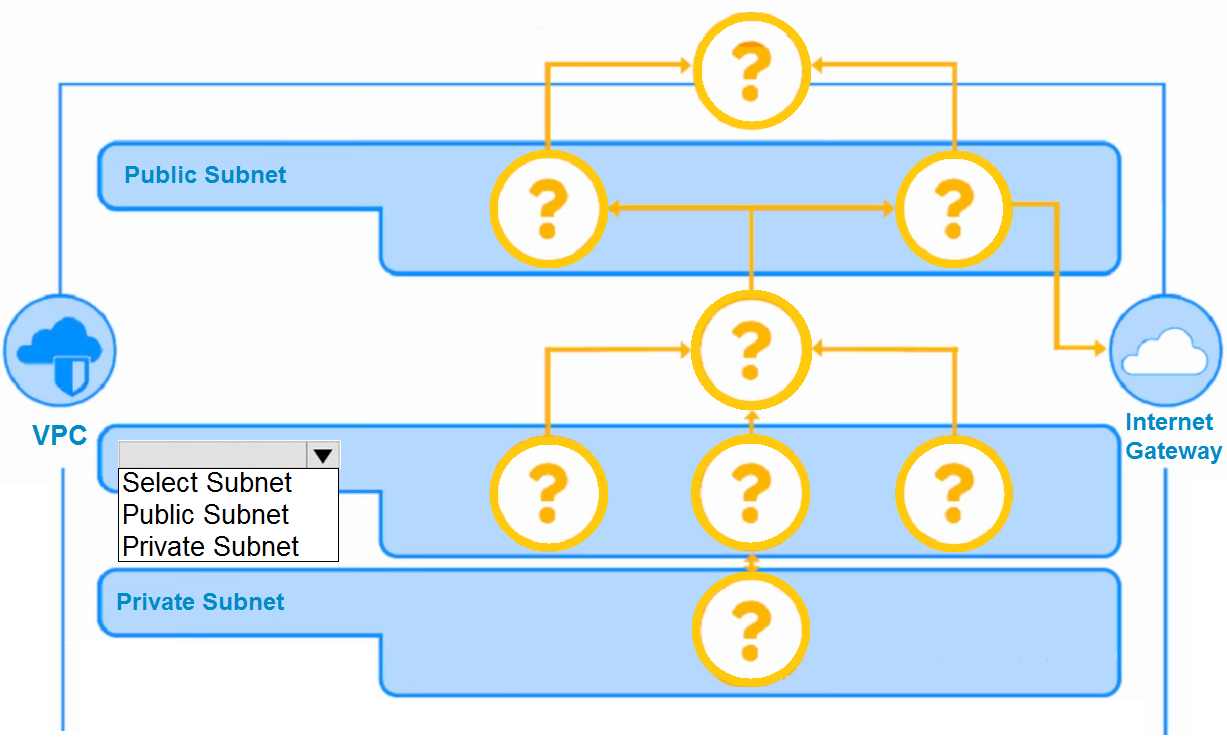
A security analyst is creating the first draft of a network diagram for the company’s new customer-facing payment application that will be hosted by a third-party cloud service provider.
INSTRUCTIONS
-
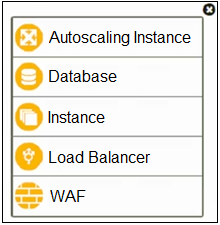
Click the ? to select the appropriate icons to create a secure, redundant web application. Then use the dropdown menu to select the appropriate subnet type. Every space in the diagram must be filled.
If at any time you would like to bring back the initial state of the simulation, please click the Reset All button.
Explanation: A secure redundant web application places a WAF in front of redundant public load balancers. Application servers run in a private subnet behind the load balancers, with an autoscaling group managing instances. The database resides in a separate private subnet.
Question 30
A program manager wants to ensure contract employees can only access the company's computers Monday through Friday from 9 a m. to 5 p.m. Which of the following would best enforce this access control?
A. Creating a GPO for all contract employees and setting time-of-day log-in restrictions
B. Creating a discretionary access policy and setting rule-based access for contract employees
C. Implementing an OAuth server and then setting least privilege for contract employees
D. Implementing SAML with federation to the contract employees’ authentication server
Show Answer
Correct Answer: A
Explanation: Time-of-day logon restrictions are designed to limit when users can authenticate. In a Windows Active Directory environment, applying these settings through a Group Policy Object (GPO) for contract employees is the appropriate way to enforce access only Monday through Friday from 9 a.m. to 5 p.m. The other options do not specifically enforce logon time restrictions: discretionary access control governs resource permissions, OAuth handles authorization, and SAML provides federated authentication.
Question 31
A growing organization, which hosts an externally accessible application, adds multiple virtual servers to improve application performance and decrease the resource usage on individual servers. Which of the following solutions is the organization most likely to employ to further increase performance and availability?
A. Load balancer
B. Jump server
C. Proxy server
D. SD-WAN
Show Answer
Correct Answer: A
Explanation: A load balancer distributes incoming client requests across multiple virtual servers, improving performance by balancing resource utilization and increasing availability by routing traffic away from failed or overloaded servers. A jump server is for administrative access, a proxy server intermediates client requests but does not primarily provide server load distribution, and SD-WAN optimizes WAN connectivity rather than balancing application traffic.
Question 32
Which of the following would most likely be deployed to obtain and analyze attacker activity and techniques?
A. Firewall
B. IDS
C. Honeypot
D. Layer 3 switch
Show Answer
Correct Answer: C
Explanation: A honeypot is specifically deployed as a decoy system to attract attackers so defenders can observe, collect, and analyze their behavior, tools, and techniques. A firewall filters traffic, an IDS detects suspicious activity but is not primarily designed to lure and study attackers, and a Layer 3 switch performs network routing/switching functions.
Question 33
Employees sign an agreement that restricts specific activities when leaving the company. Violating the agreement can result in legal consequences. Which of the following agreements does this best describe?
A. SLA
B. BPA
C. NDA
D. MOA
Show Answer
Correct Answer: C
Explanation: The agreement described is a Non-Disclosure Agreement (NDA). Employees commonly sign an NDA to protect confidential or proprietary information during and after employment. If they disclose protected information after leaving the company, they may face legal consequences. An SLA defines service levels, a BPA is a business partnership/process agreement depending on context, and an MOA is a memorandum of agreement.
Question 34
Which of the following is prevented by proper data sanitization?
A. Hackers’ ability to obtain data from used hard drives
B. Devices reaching end-of-life and losing support
C. Disclosure of sensitive data through incorrect classification
D. Incorrect inventory data leading to a laptop shortage
Show Answer
Correct Answer: A
Explanation: Proper data sanitization securely removes or destroys data on storage media so it cannot be recovered after reuse or disposal. This prevents unauthorized parties from obtaining data from used hard drives. The other options relate to lifecycle management, data classification, or asset inventory rather than sanitization.
Question 35
The number of tickets the help desk has been receiving has increased recently due to numerous false-positive phishing reports. Which of the following would be best to help to reduce the false positives?
A. Performing more phishing simulation campaigns
B. Improving security awareness training
C. Hiring more help desk staff
D. Implementing an incident reporting web page
Show Answer
Correct Answer: B
Explanation: Improving security awareness training is the best way to reduce false-positive phishing reports because it helps users better distinguish legitimate emails from actual phishing attempts. More simulations primarily assess and reinforce behavior but are less directly targeted at correcting widespread misclassification. Hiring staff addresses capacity rather than the cause, and a reporting web page changes the reporting mechanism without reducing false positives.
Question 36
A systems administrator receives a text message from an unknown number claiming to be the Chief Executive Officer of the company. The message states an emergency situation requires a password reset. Which of the following threat vectors is being used?
A. Typosquatting
B. Smishing
C. Pretexting
D. Impersonation
Show Answer
Correct Answer: B
Explanation: The threat vector is smishing, which is phishing conducted via SMS/text messages. The attacker uses a text message to create urgency and trick the administrator into performing a password reset. Although the message includes impersonation of the CEO and a fabricated emergency (pretext), the primary threat vector described is SMS-based phishing (smishing).
Question 37
Which of the following most accurately describes the order in which a security engineer should implement secure baselines?
A. Deploy, maintain, establish
B. Establish, maintain, deploy
C. Establish, deploy, maintain
D. Deploy, establish, maintain
Show Answer
Correct Answer: C
Explanation: The correct implementation lifecycle for secure baselines is to first establish the baseline by defining secure configuration standards, then deploy those configurations across systems, and finally maintain them through ongoing monitoring, updates, patching, and periodic review. This aligns with standard security configuration management practices.
$19
Get all 609 questions with detailed answers and explanations
Instant download HTML + PDF delivered the moment payment clears.
Secure Stripe checkout we never see or store your card details.
7-day refund if files are defective see our refund policy.