This is the free Comptia DY0-001 practice question bank —
50 of 82 total questions, each with a full explanation, free to
read with no signup required. Updated 2026-10-13.
Every answer is verified against official Comptia documentation —
see our methodology.
Question 1
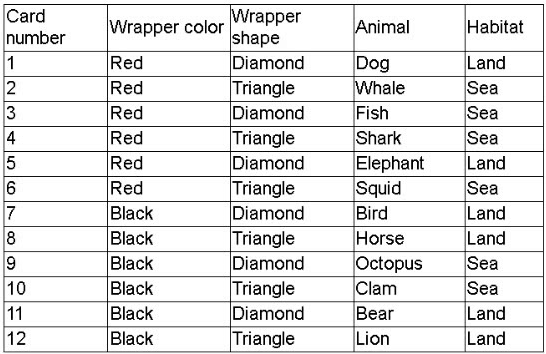
A company created a very popular collectible card set. Collectors attempt to collect the entire set, but the availability of each card varies, with because some cards have higher production volumes than others. The set contains a total of 12 cards. The attributes of the cards are below:
A data scientist is provided a historical record of cards purchased, which was acquired by a local collectors' association. The data scientist needs to design an initial model iteration to predict whether or not the animal on the card lives in the sea or on land given the provided attributes. Which of the following is the best way to accomplish this task?
A. ARIMA
B. Linear regression
C. Association rules
D. Decision trees
Show Answer
Correct Answer: D
Explanation: A decision tree is a supervised classification method that can use the card attributes to predict the categorical target, whether the animal lives in the sea or on land. ARIMA is for time-series forecasting, linear regression predicts continuous values, and association rules identify co-occurrences rather than directly classifying the target.
Question 1
Which of the following measures would a data scientist most likely use to calculate the similarity of two text strings?
A. Word cloud
B. Edit distance
C. String indexing
D. k-nearest neighbors
Show Answer
Correct Answer: B
Explanation: Edit distance measures how many insertions, deletions, or substitutions are needed to transform one text string into another, so it can be used to assess their similarity.
Question 2
A data scientist is analyzing a data set with categorical features and would like to make those features more useful when building a model. Which of the following data transformation techniques should the data scientist use? (Choose two.)
A. Normalization
B. One-hot encoding
C. Linearization
D. Label encoding
E. Scaling
F. Pivoting
Show Answer
Correct Answer: B, D
Explanation: One-hot encoding represents each category as a separate binary feature, while label encoding assigns a numeric value to each category. Both are common ways to transform categorical features for modeling.
Question 2
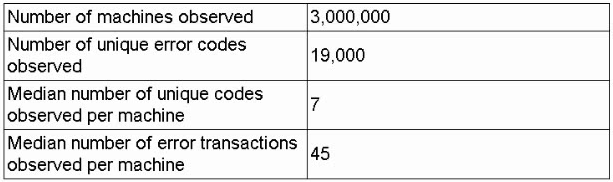
A data scientist receives an update on a business case about a machine that has thousands of error codes. The data scientist creates the following summary statistics profile while reviewing the logs for each machine:
Which of the following is the most likely concern with respect to data design for model ingestion?
A. Sparse matrix
B. Granularity misalignment
C. Insufficient features
D. Multivariate outliers
Show Answer
Correct Answer: A
Explanation: With 19,000 possible error codes but a median of only 7 unique codes per machine, a one-hot representation would contain mostly zeros. This makes a sparse matrix the main data-design concern for model ingestion.
Question 3
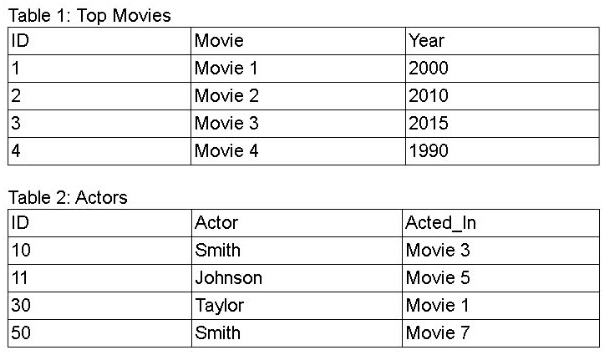
A movie production company would like to find the actors appearing in its top movies using data from the tables below. The resulting data must show all movies in Table 1, enriched with actors listed in Table 2.
Which of the following query operations achieves the desired data set?
A. Perform an INNER JOIN between Table 1 using column Movie, and Table 2 using column Acted_In.
B. Perform a UNION between Table 1 using column Movie, and Table 2 using column Acted_In.
C. Perform an INTERSECT between Table 1 using column Movie, and Table 2 using column Acted_In.
D. Perform a LEFT JOIN on Table 1 using column Movie, with Table 2 using column Acted_In.
Show Answer
Correct Answer: D
Explanation: A LEFT JOIN keeps every movie from Table 1 and adds matching actor information from Table 2. Movies without a matching actor remain in the result, with the actor fields null.
Question 3
Given these business requirements:
Needs to most efficiently move 3,000 boxes across a river
Has one boat that holds eight boxes, travels at ten nautical miles per hour, and has a fuel economy of six nautical miles per gallon
Has another boat that holds two boxes, travels at 50 nautical miles per hour, and has a fuel economy of 18 nautical miles per gallon
The river is one nautical mile wide
The data scientist only has access to 125 gallons of fuel
Which of the following is the most likely optimization technique a data scientist would apply?
A. Constrained
B. Unconstrained
C. Non-iterative
D. Iterative
Show Answer
Correct Answer: A
Explanation: This is a constrained optimization problem: the data scientist must choose how to use the boats while respecting limits such as the 125-gallon fuel supply, boat capacities, and river distance, and optimize the movement of the boxes.
Question 4
Which of the following is best solved with graph theory?
A. Optical character recognition
B. Traveling salesman
C. Fraud detection
D. One-armed bandit
Show Answer
Correct Answer: B
Explanation: The traveling salesman problem is classically modeled as a weighted graph: cities are vertices, routes are edges, and the goal is to find a minimum-cost tour visiting each city once.
Question 4
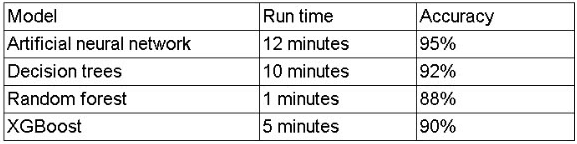
A data scientist is designing a real-time machine-learning model that classifies a user based on initial behavior. The run times of these models are provided in the following table:
Which of the following models should the data scientist recommend for deployment?
A. XGBoost
B. Random forest
C. Decision trees
D. Artificial neural network
Show Answer
Correct Answer: B
Explanation: Random forest has the shortest run time at 1 minute, making it the best fit for real-time deployment among the listed models, despite having lower accuracy than the others.
Question 5
A data scientist would like to model a complex phenomenon using a large data set composed of categorical, discrete, and continuous variables. After completing exploratory data analysis, the data scientist is reasonably certain that no linear relationship exists between the predictors and the target. Although the phenomenon is complex, the data scientist still wants to maintain the highest possible degree of interpretability in the final model. Which of the following algorithms best meets this objective?
A. Artificial neural network
B. Decision tree
C. Multiple linear regression
D. Random forest
Show Answer
Correct Answer: B
Explanation: A decision tree can model nonlinear relationships and handle categorical, discrete, and continuous predictors, while its sequence of splits is relatively easy to interpret. Neural networks and random forests are less interpretable, and multiple linear regression assumes a linear relationship.
Question 5
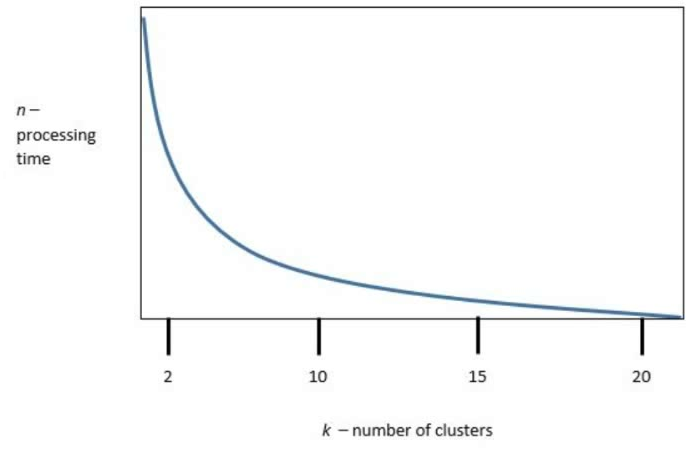
The following graphic shows the results of an unsupervised, machine-learning clustering model:
k is the number of clusters, and n is the processing time required to run the model. Which of the following is the best value of k to optimize both accuracy and processing requirements?
A. 2
B. 10
C. 15
D. 20
Show Answer
Correct Answer: B
Explanation: The curve drops sharply up to about k = 10 and then flattens, so k = 10 is the elbow: beyond it, increasing the number of clusters offers diminishing improvement relative to the processing trade-off.
$19
Get all 82 questions with detailed answers and explanations
Instant download HTML + PDF delivered the moment payment clears.
Secure Stripe checkout we never see or store your card details.
7-day refund if files are defective see our refund policy.