This is the free Amazon DOP-C02 practice question bank —
220 of 424 total questions, each with a full explanation, free to
read with no signup required. Updated 2026-10-13.
Every answer is verified against official Amazon documentation —
see our methodology.
Question 1
A company manages its multi-account environment by using AWS Organizations and AWS Control Tower. The company must deploy standardized security controls and compliance policies across all of its AWS accounts and AWS Regions. Any changes to these controls must be automatically applied to all accounts simultaneously.
The company has the required security controls and compliance policies defined in AWS Cloud Development Kit (AWS CDK) as a security controls construct.
Which solution will deploy these controls across all accounts and Regions with the LEAST operational overhead?
A. Create an AWS CDK app that includes an AWS CloudFormation StackSets construct. Configure the StackSets construct to use the security controls construct as its template. Specify the target accounts and Regions. Create automation to deploy the CDK app to create and manage the CloudFormation stack set.
B. Create an AWS CDK app that synthesizes an AWS CloudFormation template from the security controls construct. Use Amazon EventBridge to invoke an AWS Lambda function to update a CloudFormation stack set when changes are made to the security controls construct.
C. Convert the security controls construct to an AWS CloudFormation macro. Create a CloudFormation stack set that references the macro and deploys the macro to all target accounts. Use Organizations to automatically add new accounts to the stack set’s list of target accounts.
D. Use AWS Control Tower to create a customized landing zone that includes configurations from the security controls construct. Configure AWS Control Tower to automatically enroll new accounts and to apply the landing zone template.
Show Answer
Correct Answer: A
Explanation: A CloudFormation StackSet can deploy the existing CDK-defined controls across the target accounts and Regions, then propagate updates through the same deployment process. Control Tower does not directly accept a CDK construct as a landing zone configuration, so D would require additional customization tooling.
Question 1
A company uses an organization in AWS Organizations that a security team and a DevOps team manage. Both teams access the accounts by using AWS IAM Identity Center.
A dedicated group has been created for each team. The DevOps team's group has been assigned a permission set named DevOps. The permission set has the AdministratorAccess managed IAM policy attached. The permission set has been applied to all accounts in the organization.
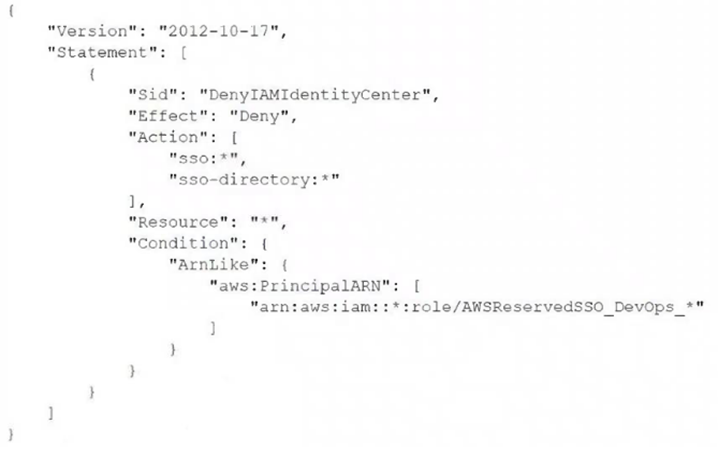
The security team wants to ensure that the DevOps team does not have access to IAM Identity Center in the organization's management account. The security team has attached the following SCP to the organization root:
After implementing the policy, the security team discovers that the DevOps team can still access IAM Identity Center.
Which solution will fix the problem?
A. In the organization's management account, create a new OU. Move the organization's management account to the new OU. Detach the SCP from the organization root. Attach the SCP to the new OU.
B. In the organization's management account, update the SCP condition reference to the ARN of the DevOps team's group role to include the AWS account ID of the organization's management account.
C. In IAM Identity Center, create a new permission set. Ensure that the assigned policy has full access but explicitly denies permission for the sso:* action and the sso-directory:* action. Update the assigned permission set for the DevOps team's group role in the organization's management account. Delete the SCP.
D. In IAM Identity Center, update the DevOps permission set. Ensure that the assigned policy has full access but explicitly denies permission for the sso:* action and the sso-directory:* action. In the Deny statement, add a StringEquals condition that compares the aws:SourceAccount global condition context key with the organization's management account IDelete the SCP.
Show Answer
Correct Answer: C
Explanation: SCPs do not restrict principals in an AWS Organizations management account, so moving or changing the SCP will not fix this. Assigning the DevOps group a separate permission set for that account allows an explicit deny of `sso:*` and `sso-directory:*` while retaining its other permissions. Option D relies on `aws:SourceAccount`, which is not a reliable condition for direct user requests.
Sources:
https://aws.amazon.com/blogs/security/delegating-permission-set-management-and-account-assignment-in-aws-iam-identity-center
Question 1
An ecommerce company hosts a web application on Amazon EC2 instances that are in an Auto Scaling group. The company deploys the application across multiple Availability Zones.
Application users are reporting intermittent performance issues with the application.
The company enables basic Amazon CloudWatch monitoring for the EC2 instances. The company identifies and implements a fix for the performance issues. After resolving the issues, the company wants to implement a monitoring solution that will quickly alert the company about future performance issues.
Which solution will meet this requirement?
A. Enable detailed monitoring for the EC2 instances. Create custom CloudWatch metrics for application-specific performance indicators. Set up CloudWatch alarms based on the custom metrics. Use CloudWatch Logs Insights to analyze application logs for error patterns.
B. Use AWS X-Ray to implement distributed tracing. Integrate X-Ray with Amazon CloudWatch RUM. Use Amazon EventBridge to trigger automatic scaling actions based on custom events.
C. Use Amazon CloudFront to deliver the application. Use AWS CloudTrail to monitor API calls. Use AWS Trusted Advisor to generate recommendations to optimize performance. Use Amazon GuardDuty to detect potential performance issues.
D. Enable VPC Flow Logs. Use Amazon Data Firehose to stream flow logs to Amazon S3. Use Amazon Athena to analyze the logs and to send alerts to the company.
Show Answer
Correct Answer: A
Explanation: Detailed CloudWatch monitoring provides higher-frequency EC2 metrics (1-minute instead of basic 5-minute), enabling faster detection. Custom CloudWatch metrics allow monitoring application-specific performance indicators, and CloudWatch alarms can notify the team immediately when thresholds are breached. CloudWatch Logs Insights complements monitoring by helping investigate error patterns after alerts. The other options focus on tracing, network analysis, or unrelated services rather than fast operational alerting for application performance.
Sources:
https://codingnconcepts.com/aws/aws-certified-solutions-architect-associate-exam-questions
Question 2
A company has an organization in AWS Organizations. A DevOps engineer needs to maintain multiple AWS accounts that belong to different OUs in the organization. All resources, including IAM policies and Amazon S3 policies within an account, are deployed through AWS CloudFormation. All templates and code are maintained in an AWS CodeCommit repository. Recently, some developers have not been able to access an S3 bucket from some accounts in the organization.
The following policy is attached to the S3 bucket:
What should the DevOps engineer do to resolve this access issue?
A. Modify the S3 bucket policy. Turn off the S3 Block Public Access setting on the S3 bucket. In the S3 policy, add the aws:SourceAccount condition. Add the AWS account IDs of all developers who are experiencing the issue.
B. Verify that no IAM permissions boundaries are denying developers access to the S3 bucket. Make the necessary changes to IAM permissions boundaries. Use an AWS Config recorder in the individual developer accounts that are experiencing the issue to revert any changes that are blocking access. Commit the fix back into the CodeCommit repository. Invoke deployment through CloudFormation to apply the changes.
C. Configure an SCP that stops anyone from modifying IAM resources in developer OUs. In the S3 policy, add the aws:SourceAccount condition. Add the AWS account IDs of all developers who are experiencing the issue. Commit the fix back into the CodeCommit repository. Invoke deployment through CloudFormation to apply the changes.
D. Ensure that no SCP is blocking access for developers to the S3 bucket. Ensure that no IAM policy permissions boundaries are denying access to developer IAM users. Make the necessary changes to the SCP and IAM policy permissions boundaries in the CodeCommit repository. Invoke deployment through CloudFormation to apply the changes.
Show Answer
Correct Answer: D
Explanation: The bucket policy allows the requested actions, but access can still be blocked by an explicit deny in an Organizations SCP or by an IAM permissions boundary. Check both controls for the affected accounts and roles, make any required changes in the CloudFormation-managed code in CodeCommit, and deploy the updates through CloudFormation. An AWS Config recorder alone does not automatically revert access-blocking changes.
Question 2
A company uses AWS Organizations to manage multiple AWS accounts. The accounts are in an OU that has a policy attached to allow all actions. The company is migrating several Git repositories to a specified AWS CodeConnections supported Git provider. The Git repositories manage AWS CloudFormation stacks for application infrastructure that the company deploys across multiple AWS Regions.
The company wants a DevOps team to integrate CodeConnections into the CloudFormation stacks. The DevOps team must ensure that company staff members can integrate only with the specified Git provider. The deployment process must be highly available across Regions.
Which combination of steps will meet these requirements? (Choose three.)
A. Add a new SCP statement to the OU that denies the CodeConnections CreatingConnections action where the provider type is not the specified Git provider.
B. Add a new SCP statement to the OU that allows the CodeConnections CreatingConnections action where the provider type is the specified Git provider.
C. Use CodeConnectlons to configure a single CodeConnections connection to each Git repository.
D. Use CodeConnections to create a CodeConnections connection from each Region where the company operates to each Git repository.
E. Use CodeConnections to create a CodeConnections repository link. Update each CfoudFormation stack to sync from the Git repository.
F. For each Git repository, create a pipeline in AWS CodePipefine that has the Git repository set as the source and a CloudFormation deployment stage.
Show Answer
Correct Answer: A, D, E
Explanation: A deny SCP restricts connection creation to the specified Git provider; an additional allow SCP is unnecessary because the OU already allows all actions. CodeConnections connections are regional, so creating them in each deployment Region supports regional availability. Repository links and CloudFormation Git sync then connect the stacks directly to their Git repositories.
Question 2
A company deploys a web application on Amazon EC2 instances that are behind an Application Load Balancer (ALB). The company stores the application code in an AWS CodeConnections compatible Git repository.
When the company merges code to the main branch, an AWS CodeBuild project is initiated. The CodeBuild project compiles the code, stores the packaged code in AWS CodeArtifact, and invokes AWS Systems Manager Run Command to deploy the packaged code to the EC2 instances.
Previous deployments have resulted in defects, EC2 instances that were not running the latest version of the packaged code, and inconsistencies between instances. A DevOps engineer needs to improve the reliability of the deployment solution.
Which combination of actions will meet this requirement? (Choose two.)
A. Create a pipeline in AWS CodePipeline that uses the Git repository as the source provider. Configure the pipeline to have parallel build and test stages. In the pipeline, pass the CodeBuild project output artifact to an AWS CodeDeploy action.
B. Create a pipeline in AWS CodePipeline that uses the Git repository as the source provider. Configure the pipeline to have a build stage followed by a test stage. In the pipeline, pass the CodeBuild project output artifact to an AWS CodeDeploy action.
C. Create an AWS CodeDeploy application and a deployment group to deploy the packaged code to the EC2 instances. Configure the ALB for the deployment group.
D. Create individual AWS Lambda functions that use AWS CodeDeploy instead of Systems Manager to run build, test, and deploy actions.
E. Create an Amazon S3 bucket. Modify the CodeBuild project to store the packages in the S3 bucket instead of in CodeArtifact. Use deploy actions in CodeDeploy to deploy the artifact to the EC2 instances.
Show Answer
Correct Answer: B, C
Explanation: Use CodePipeline to orchestrate a sequential build then test workflow before deployment, and use CodeDeploy with an EC2 deployment group integrated with the Application Load Balancer for consistent, reliable deployments with deployment tracking and instance coordination. CodeDeploy for EC2 expects application revisions from Amazon S3 or GitHub, not CodeArtifact directly, so storing build artifacts in S3 is the standard deployment pattern; parallel build/test is inappropriate because tests depend on build output.
Sources:
https://www.certqueen.com/DOP-C02-exam.html
Question 3
A company deploys an application to Amazon EC2 instances. The application runs Amazon Linux 2 and uses AWS CodeDeploy. The application has the following file structure for its code repository:
The appspec.yml file has the following contents in the files section:
What will the result be for the deployment of the config.txt file?
A. The config.txt file will be deployed to only /var/www/html/config/config.txt.
B. The config.txt file will be deployed to /usr/local/src/config.txt and to /var/www/html/config/config.txt.
C. The config.txt file will be deployed to only /usr/local/src/config.txt.
D. The config.txt file will be deployed to /usr/local/src/config.txt and to /var/www/html/application/web/config.txt.
Show Answer
Correct Answer: B
Explanation: The first mapping copies config/config.txt to /usr/local/src/config.txt. The second mapping copies the repository contents to /var/www/html, placing the same file at /var/www/html/config/config.txt.
Question 3
A company uses an AWS CodeArtifact repository to store Python packages that the company developed internally. A DevOps engineer needs to use AWS CodeDeploy to deploy an application to an Amazon EC2 instance. The application uses a Python package that is stored in the CodeArtifact repository. A BeforeInstall lifecycle event hook will install the package.
The DevOps engineer needs to grant the EC2 instance access to the CodeArtifact repository.
Which solution will meet this requirement?
A. Create a service-linked role for CodeArtifact. Associate the role with the EC2 instance. Use the aws codeartifact get-authorization-token CLI command on the instance.
B. Configure a resource-based policy for the CodeArtifact repository that allows the ReadFromRepository action for the EC2 instance principal.
C. Configure ACLs on the CodeArtifact repository to allow the EC2 instance to access the Python package.
D. Create an instance profile that contains an IAM role that has access to CodeArtifact. Associate the instance profile with the EC2 instance. Use the aws codeartifact login CLI command on the instance.
Show Answer
Correct Answer: D
Explanation: Attach an IAM role with the required CodeArtifact permissions to the EC2 instance through an instance profile. The `aws codeartifact login` command configures the package manager (such as pip) to authenticate to the repository using the instance role’s credentials.
Question 3
A company wants to improve its security practices by enforcing least privilege across all projects. Developers must be able to access Amazon EC2 resources but not Amazon RDS resources. Database administrators must have access only to Amazon RDS resources.
Every employee has a unique IAM user. There are already pre-existing IAM policies for developer and database administrator job functions. All AWS resources are already tagged with appropriate project tags. All the IAM users are tagged with the appropriate project and job function.
The company must ensure that each employee can access only the project that the employee is working on.
Which solution will meet these requirements? (Choose three.)
A. For each project, create one IAM role for developers and one IAM role for database administrators. Tag the IAM roles with the corresponding projects and job functions.
B. Modify the pre-existing IAM policies to include a StringEquals ResourceTag condition for projects that match the PrincipalTag value. Attach the modified policies to the IAM roles for each job function.
C. Create an IAM policy that allows users to assume a role when the ResourceTag value matches the PrincipalTag value for project tags and job title tags. Attach the new policy to all IAM users.
D. Create an IAM policy that allows users to assume a role when the ResourceTag value matches the PrincipalTag value for project tags and job title tags. Attach the new policy to the IAM roles for each job function.
E. Tag the pre-existing IAM policies with the appropriate projects and job functions. Attach the modified policies to IAM roles for each job function.
F. For each project, create one IAM group for developers and one IAM group for database administrators. Add the appropriate users to each group so the users can assume their respective IAM roles.
Show Answer
Correct Answer: A, B, C
Explanation: Use IAM roles per project/job function, ABAC conditions comparing principal tags to resource tags in the permissions policies, and a user policy permitting AssumeRole only when the target role's tags match the user's project and job-function tags.
Question 4
A company's development team uses AWS CloudFormation to deploy its application resources. The team must use CloudFormation for all changes to the environment. The team cannot use the AWS Management Console or the AWS CLI to make manual changes directly.
The team uses a developer IAM role to access the environment. The role is configured with the AdministratorAccess managed IAM policy. The company has created a new CloudFormationDeployment IAM role that has the following policy attached:
The company wants to ensure that only CloudFormation can use the new role. The development team cannot make any manual changes to the deployed resources.
Which combination of steps will meet these requirements? (Choose three.)
A. Remove the AdministratorAccess policy. Assign the ReadOnlyAccess managed IAM policy to the developer role. Instruct the developers to use the CloudFormationDeployment role as a CloudFormation service role when the developers deploy new stacks.
B. Update the trust policy of the CloudFormationDeployment role to allow the developer IAM role to assume the CloudFormationDeployment role.
C. Configure the developer IAM role to be able to get and pass the CloudFormationDeployment role if iam:PassedToService equals . Configure the CloudFormationDeployment role to allow all cloudformation actions for all resources.
D. Update the trust policy of the CloudFormationDeployment role to allow the cloudformation.amazonaws.com AWS principal to perform the iam:AssumeRole action.
E. Remove the AdministratorAccess policy. Assign the ReadOnlyAccess managed IAM policy to the developer role. Instruct the developers to assume the CloudFormationDeployment role when the developers deploy new stacks.
F. Add an IAM policy to the CloudFormationDeployment role to allow cloudformation:* on all resources. Add a policy that allows the iam:PassRole action for the ARN of the CloudFormationDeployment role if iam:PassedToService equals cloudformation.amazonaws.com.
Show Answer
Correct Answer: A, D, F
Explanation: A removes the developer role’s direct administrative permissions, so developers cannot make resource changes outside CloudFormation. D makes CloudFormation the trusted principal allowed to assume the deployment role. F is intended to provide CloudFormation permissions and restrict passing the role to CloudFormation only. Note: as written, A grants only ReadOnlyAccess, which does not let developers create or update stacks; they would also need CloudFormation stack-operation permissions on their role, with iam:PassRole limited to this deployment role.
$19
Get all 424 questions with detailed answers and explanations
Instant download HTML + PDF delivered the moment payment clears.
Secure Stripe checkout we never see or store your card details.
7-day refund if files are defective see our refund policy.